
Learn what ruqyah actually is in Islam, what makes it permissible, how it differs from haram practices, and how to use it for protection and healing from sihr, evil eye, and jinn.
You have heard the word ruqyah. Maybe someone told you to “get ruqyah done.” Maybe you searched online and found videos of people screaming during recitation, or websites selling ruqyah sessions for hundreds of pounds. Maybe a family member recommended a “healer” and you are not sure whether what they do is Islamic or not.
The confusion is understandable. Ruqyah has been surrounded by so much misinformation, cultural baggage, and outright fraud that many Muslims do not know what it actually is, whether it is safe, or how it differs from the questionable practices that scholars warn about.
The truth is simpler than the confusion suggests. Ruqyah is one of the clearest, most well-documented practices in the Sunnah. The Prophet ﷺ did it. Jibreel (A.S) taught it to him. The companions (R.A) used it. And it is something you can do for yourself, your children, and your family without needing anyone else’s permission or expertise.
What ruqyah actually is
Ruqyah means using Qur’anic verses, authentic prophetic du’as, and permissible supplications as a means of seeking healing and protection from Allah. The belief at its core is that cure comes only from Allah, and that ruqyah is a means He has provided, not a power that operates independently.
If you have ever recited Surah al-Ikhlas, al-Falaq, and al-Nas over yourself or your child and blown, you have already performed ruqyah. If you have placed your hand on a place of pain and said “Bismillah,” you have performed ruqyah. If you have recited Ayat al-Kursi before sleep seeking Allah’s protection, you have performed ruqyah.
It is not a mysterious advanced technique hidden for specialists. It is an act of worship that the Prophet ﷺ taught the entire Ummah, and it is one of the most powerful tools a believer has for dealing with spiritual affliction.
Ruqyah includes reciting Qur’an with the intention of healing or protection, reciting du’as from the Sunnah, making du’a in your own words and language with correct belief, and using daily adhkar as a consistent shield. All of these fall under the umbrella of ruqyah when done with the intention of seeking Allah’s protection and healing.
The evidence from Qur’an and Sunnah
Ruqyah is not a cultural invention or a recent trend. It goes back to the earliest generations and is rooted directly in revelation.
The Qur’an describes itself as healing: “And We send down in the Qur’an that which is a healing and mercy for the believers” (Surah al-Isra, 17:82). And: “O mankind, there has come to you an instruction from your Lord, and a healing for what is in the breasts, and guidance and mercy for the believers” (Surah Yunus, 10:57).
The Prophet ﷺ practised ruqyah regularly. He used to recite Surah al-Falaq and Surah al-Nas over himself when ill. When he became too weak, ‘Aishah (R.A) would recite them over him and rub his hands over his body. He ﷺ said: “There is nothing wrong with ruqyah that does not involve shirk” (Muslim). And he ﷺ affirmed: “Allah did not send down a disease except that He sent down for it a cure” (Muslim).
Jibreel (A.S) himself performed ruqyah for the Prophet ﷺ, saying: “In the Name of Allah I perform ruqyah over you, from everything that harms you, from the evil of every soul or envious eye. May Allah cure you; in the Name of Allah I perform ruqyah over you.”
The companions (R.A) used it in practice. A group of companions (R.A) recited Surah al-Fatiha over a man who had been stung by a scorpion, and he recovered as if freed from chains. When they reported this to the Prophet ﷺ, he approved of their action and said: “How did you know that it was a ruqyah?”
The Prophet ﷺ also used to seek refuge for his grandsons al-Hasan and al-Husayn (R.A) with a du’a that Ibrahim (peace be upon him) had used for his own sons Isma’il and Ishaq (A.S): “I seek refuge for you both in the perfect words of Allah from every devil and poisonous creature, and from every harmful eye.” This tells us that ruqyah was not unique to this Ummah. It is a prophetic practice stretching back through generations.
When the Prophet ﷺ faced direct jinn aggression during the Night Journey, Jibreel (A.S) did not tell him to bargain with the jinn or fight them physically. He taught him words of isti’adhah, seeking refuge in Allah’s Noble Face and His complete words from all created harm. Protection was anchored in Allah’s words, which no creature can overstep.
The Prophet ﷺ also taught specific du’as for illness and pain. He instructed the sick person to place their hand on the area of pain, say “Bismillah” three times, then say seven times: “I seek refuge in Allah and His Power from the evil of what I feel and what I fear.” And he taught: “O Allah, Lord of mankind, remove this disease and cure him. You are the Great Curer; there is no cure but through You, a cure that leaves behind no disease.”
These narrations establish that ruqyah is real, effective, and part of the prophetic model. It is permissible and recommended when kept within tawheed. It is not new and it is not fringe. It goes back to the Prophet ﷺ himself, to Jibreel (A.S), and to Ibrahim (A.S) before him.
Why Qur’an is the antidote to sihr
This point is important enough to understand clearly, because it explains why ruqyah works against black magic at a fundamental level, not just as a general “spiritual practice.”
Black magic at its core is not vague darkness or bad energy. Sihr is built with specific words and actions that anger Allah and please shayatin. The magician calls upon devils using incantations of shirk and kufr. He may insult or desecrate the Qur’an, make offerings to other than Allah, prostrate to stars or idols, or write Qur’anic verses in filth or reversed. In exchange for these acts of disbelief, shayatin accept the “contract” and are sent to enforce harm against the target. Sihr is, at its heart, speech and action that turn away from Allah and towards devils.
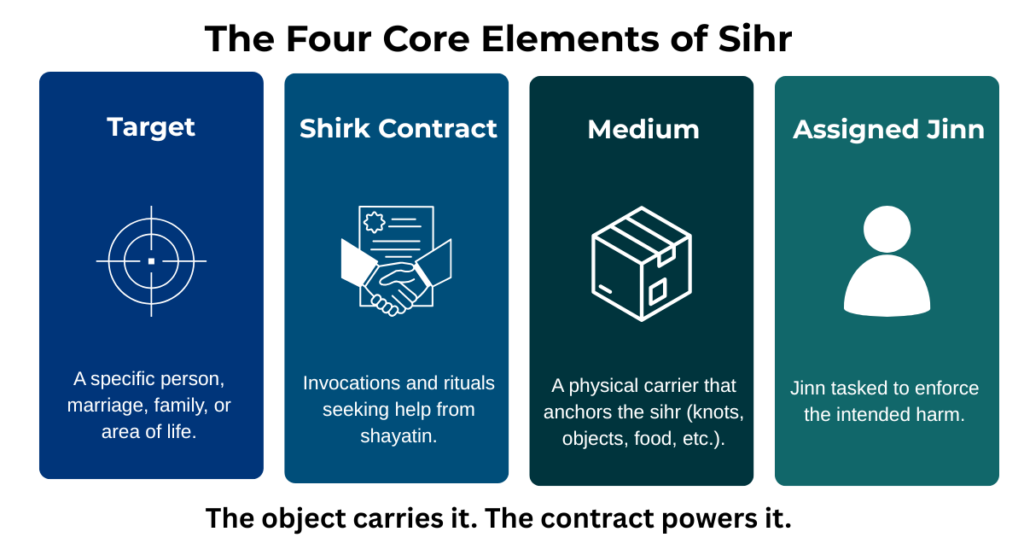
Ruqyah with Qur’an is the exact opposite of this process. The same medium, speech, is used, but in the opposite direction. Instead of calling on jinn, we call on Allah alone. Instead of words of shirk and distortion, we recite pure tawheed and verses that declare Allah’s oneness, power, and dominance over all creation. Instead of begging devils to harm, we ask the Lord of the devils to protect, heal, and destroy what they have done.
Sihr is built with words of shirk. Ruqyah is built with words of tawheed. Sihr is a contract written against you. Qur’an is the covenant you renew with Allah. The magicians and their works are weak in front of Allah and His speech. Their supplications to devils cannot stand in front of pure tawheed, those weighty verses which, if they were revealed upon a mountain, would cause it to crumble from the fear of Allah (Surah al-Hashr, 59:21).
When the Prophet ﷺ himself was afflicted with magic, Allah did not send him to a counter-magician. Allah revealed two surahs specifically for his cure: Surah al-Falaq and Surah al-Nas. In them, we are commanded to seek refuge in Allah from those who blow on knots, from the envier when he envies, and from the whispering of devils among jinn and men. The Prophet ﷺ held firmly to these surahs and recited them regularly over himself as ruqyah.
For a person afflicted by magic, this is central: the same tongue that was targeted by the shirki words of a magician can become the tongue that recites words of tawheed until the contract breaks.
The conditions of permissible ruqyah
Not everything called “ruqyah” is actually ruqyah. The Prophet ﷺ set clear boundaries. Permissible ruqyah rests on three principles:
The words used are from the Qur’an, authentic du’as, or clear permissible supplications with a sound meaning. The language is understandable; the patient knows what is being said. And the heart believes firmly that Allah alone cures, and that ruqyah is only a means which succeeds or fails by His permission.
Anything that breaks these principles is suspect at best and may be outright shirk. When someone recites Qur’an over you and you understand what they are saying, and they tell you to put your trust in Allah, you are on safe ground. When someone mutters words you cannot understand, writes symbols you cannot read, and tells you not to open the paper, you are not on safe ground.
How to tell the difference between ruqyah and haram practices
This is where many Muslims get confused, because the people offering haram services often present themselves as Islamic healers. They may use some Qur’an, wear Islamic clothing, and speak with religious authority. But their methods betray them.
Warning signs that a “healer” has crossed the line include unreadable symbols, grids, numbers, and letters written in strange ways. Papers to be burned, buried, thrown into filth, or mixed into drinks without evidence from the Sunnah. A healer who boasts about “controlling” or “using” jinn, or who speaks casually about “good jinn” who serve him. Requests for peoples names and birth details to “calculate” something. Instructions to perform acts of clear disobedience: slaughtering without Allah’s name, missing prayers, offering food or incense to “spirits,” placing objects in cemeteries and impure places. Praying salaah in a direction away from Qiblah. Instructions to put your underwear and nails in rivers. Amulets and ta’weez with unknown content, or with Qur’anic verses mixed with symbols, written backwards, or placed in sand from cemeteries.
Some of these practices are pure trickery. Others involve real cooperation with shayatin. In both cases, they are not the prophetic cure. They are part of the disease. The very contract that bound the victim in the first place is often being renewed and reinforced under the label of “treatment.”
This is why the Prophet ﷺ warned strongly against fortune-tellers, soothsayers, and magicians, and why he described certain forms of magic as kufr. Whenever a healer’s “power” depends on pleasing devils, the patient may feel relief in one area only to be bound more deeply in another.
The line is simple: if the treatment is built on Qur’an, authentic du’a, and trust in Allah, it is ruqyah. If it requires secrecy, unknown words, acts of disobedience, or dependence on a practitioner’s special relationship with jinn, it is not ruqyah, no matter what it is called.
Can you do ruqyah on yourself?
Yes. Self-ruqyah is not a compromise or a lesser alternative. It is the prophetic model.
The Prophet ﷺ recited over himself. ‘Aishah recited over him. Parents recite over their children. Companions recited over strangers. Ruqyah was taught as a tool of the whole Ummah, not a closed profession owned by a few special figures.
One of the tragedies of our time is that ruqyah has been turned into an industry where people feel they cannot heal without booking sessions with a practitioner. Seeking help from a knowledgeable person is permissible, but dependence should be on Allah, not on personalities. A person who recites Qur’an over themselves with sincere intention and correct belief is doing exactly what the Prophet ﷺ did.
The free 14-day self-ruqyah plan gives you a structured, day-by-day method for treating yourself at home. It is built on symptom-based Qur’anic recitation with specific intentions, not general reading. You recite for the specific symptom or blockage you are experiencing, with a targeted intention, alongside practical real-world effort. No dependency on a practitioner. No ta’weez. No jinn services.
Why ruqyah must be the centre of treatment
For spiritual afflictions, many tools can play a supporting role: medical treatment for genuine illnesses, psychological support and structured thinking, hijamah, black seed, honey, olive oil, and other prophetic remedies, lifestyle changes, repentance, and removing haram from your life. All of these matter, and the Foundations Series covers them in depth.
But ruqyah remains the centre for several reasons.
Mystical afflictions are fundamentally speech-based contracts. Sihr is done through words that anger Allah and please shayatin. The response begins with Allah’s words, recited, believed in, and repeated until those contracts are broken.
Ruqyah constantly restores tawheed. A person under affliction often feels small, weak, and overpowered. As they recite verses like “And Allah is predominant over His affair” and reflect on them, their inner map shifts. The sorcerer, the eye, and the jinn shrink back to their true size. Allah’s control and mercy come back to the front. This change in belief is not a side effect. It is itself a form of healing.
Ruqyah is accessible. A person may have no money for specialists, no trustworthy raqi nearby, no supportive family. But they almost always have a mushaf, a tongue, and a heart that can turn to Allah.
And ruqyah keeps the line clear between seeking means and falling into shirk. When you recite Qur’an, use prophetic du’as, give charity, and clean your life of disobedience, you may struggle and progress may feel slow, but you are on safe ground. Your battle is taking place inside obedience. When you cross into ta’weez of unknown content, jinn contracts, and acts of disobedience, you may see quick “results,” but at the cost of your tawheed and your akhirah.
What to do next
Assess your situation. If you are unsure whether what you are experiencing has a spiritual component, the diagnostic quiz walks you through a structured self-assessment across six areas of your life.
Start treating yourself. The free 14-day self-ruqyah plan gives you a structured method you can begin at home today. It covers what to recite, how to recite it, what intentions to set, and how to combine spiritual treatment with practical effort.
Understand what you might be facing. Each of the three doors of spiritual affliction has its own detailed guide:
- Signs of Evil Eye in Islam: How ‘Ayn and Hasad Actually Work
- Signs of Sihr in Islam: What Black Magic Actually Looks Like
- Signs of Jinn in Islam: How Jinn Interference Actually Works
Get personalised guidance. If you have been treating for a while and need help identifying what you are dealing with or building a targeted plan, find out how we can help.
Frequently Asked Questions
Is ruqyah allowed in Islam? Yes. Ruqyah is explicitly established in the Qur’an and Sunnah. The Prophet ﷺ practised it, Jibreel taught it to him, and the companions used it. The Prophet ﷺ said: “There is nothing wrong with ruqyah that does not involve shirk” (Muslim). It is not merely allowed but recommended as the primary response to spiritual affliction.
Can women do ruqyah? Yes. There is no restriction on women performing ruqyah. ‘Aishah used to recite ruqyah over the Prophet ﷺ himself. A woman can recite over herself, her children, her husband, and other family members. The evidence for ruqyah is general and applies to all believers regardless of gender.
Can you do ruqyah on yourself? Yes, and self-ruqyah is the prophetic model. The Prophet ﷺ recited over himself regularly. You do not need a practitioner to perform ruqyah. A person who recites Qur’an over themselves with sincere intention and correct belief is following the Sunnah directly. Seeking help from a knowledgeable person is permissible, but dependence should be on Allah, not on any individual.
Is listening to ruqyah recordings the same as reciting yourself? Listening to Qur’an has benefit and barakah, but it is not the same as reciting yourself. When you recite, you are actively engaging your tongue, your heart, and your intention. You are making a conscious act of turning to Allah. Recordings can be a helpful supplement, especially when a person is too weak or overwhelmed to recite, but they should not replace personal recitation as the foundation of treatment.
How long does ruqyah take to work? There is no fixed timeline. Some people notice changes within the first few days of consistent treatment. Others take weeks or months, depending on the type and severity of the affliction, their consistency, their spiritual state, and Allah’s decree. What matters is not speed but steadiness. A person who treats consistently for 14 days and evaluates their progress is in a much stronger position than someone who does an intense session once and then stops. The 14-day self-ruqyah plan is designed around this principle of structured, consistent treatment with built-in evaluation.
What Qur’an should I recite for ruqyah? The core recitations taught in the Sunnah include Surah al-Fatiha, Ayat al-Kursi, the last two verses of Surah al-Baqarah, and the three Mu’awwidhat (Surah al-Ikhlas, al-Falaq, and al-Nas). Beyond these, specific verses may be relevant depending on what you are experiencing. The RK method uses Ayat al-Kursi recited with specific intentions matched to your symptoms, which is covered in the 14-day plan.
The Foundations Series
This is Part 5 of the Foundations Series, covering the Islamic foundations of spiritual affliction and healing.
- Part 1: Sihr, Evil Eye, or Jinn: How to Tell the Difference
- Part 2: Signs of Evil Eye in Islam: How ‘Ayn and Hasad Actually Work
- Part 3: Signs of Sihr in Islam: What Black Magic Actually Looks Like
- Part 4: Signs of Jinn in Islam: How Jinn Interference Actually Works
- Part 5: How Sihr, the Jinn and Evil Eye Cause Blockages in Your Life
- Part 6: What Is Ruqyah? (you are here)
- Part 7: Treatment Tools That Support Ruqyah