
Sihr, jinn, and the evil eye do not just cause random problems. They engineer blockages by combining external disruption with internal collapse. Learn how the mechanism works.
Something in your life is not moving. Maybe it is your career, your marriage, your health, your studies, or your connection to Allah. Maybe it is several of these at once. You have tried the normal solutions. You have worked harder, changed your approach, seen doctors, made du’a. Some things improved temporarily, but the core pattern did not break. The same kind of failure keeps happening in the same area, and at some point the explanations you have been giving yourself stopped being convincing.
If you have read the earlier posts in this series, you already know what sihr, the evil eye, and jinn are. You may have read the signs of each one. You may have taken the diagnostic quiz and seen where the patterns are strongest. But knowing what may be present does not yet tell you how it is working inside your life. And understanding how it works is what makes the difference between feeling like a helpless victim of something invisible and knowing exactly what you are fighting.
This post is about the mechanism. Not the labels, not the symptoms list, but how sihr, jinn, and the evil eye actually engineer a blockage in a person’s life, how they maintain it, and why so many people stay stuck even when they are trying hard to get out.
Where afflictions show up
Mystical afflictions do not scatter randomly across a person’s life. They concentrate in recognisable areas: life progress and opportunities, emotions and thinking, physical health, sleep and dreams, worship and iman, and relationships, family, and the home environment.
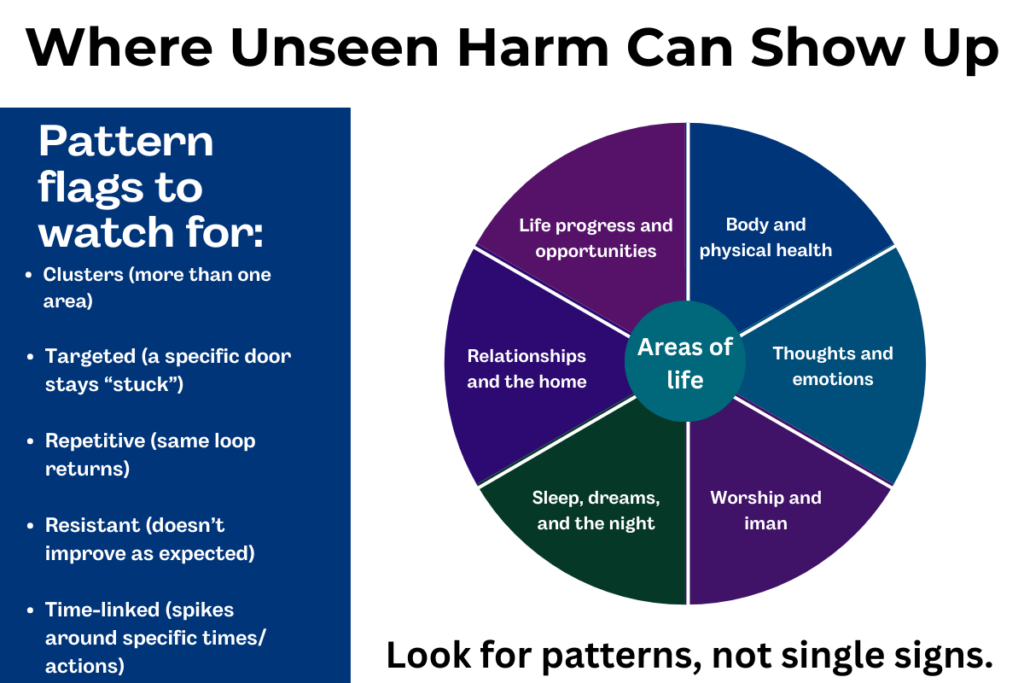
Not every problem in these areas is spiritual. Illness, grief, relationship conflict, career setbacks, and spiritual dryness are all part of ordinary life. What raises concern is when problems cluster across several of these domains at the same time, in patterns that feel targeted, repetitive, or resistant to normal solutions. A person dealing with a work blockage who also has disturbed sleep, unexplained physical symptoms, and increasing difficulty in worship is showing a different picture than someone who simply had a bad quarter at work.
If you want to assess your own situation across these areas in detail, the Am I Affected? page walks you through each domain and includes a structured diagnostic quiz. What follows here is not about identifying whether you are affected. It is about understanding how the affliction operates once it is present.
The two layers of a blockage
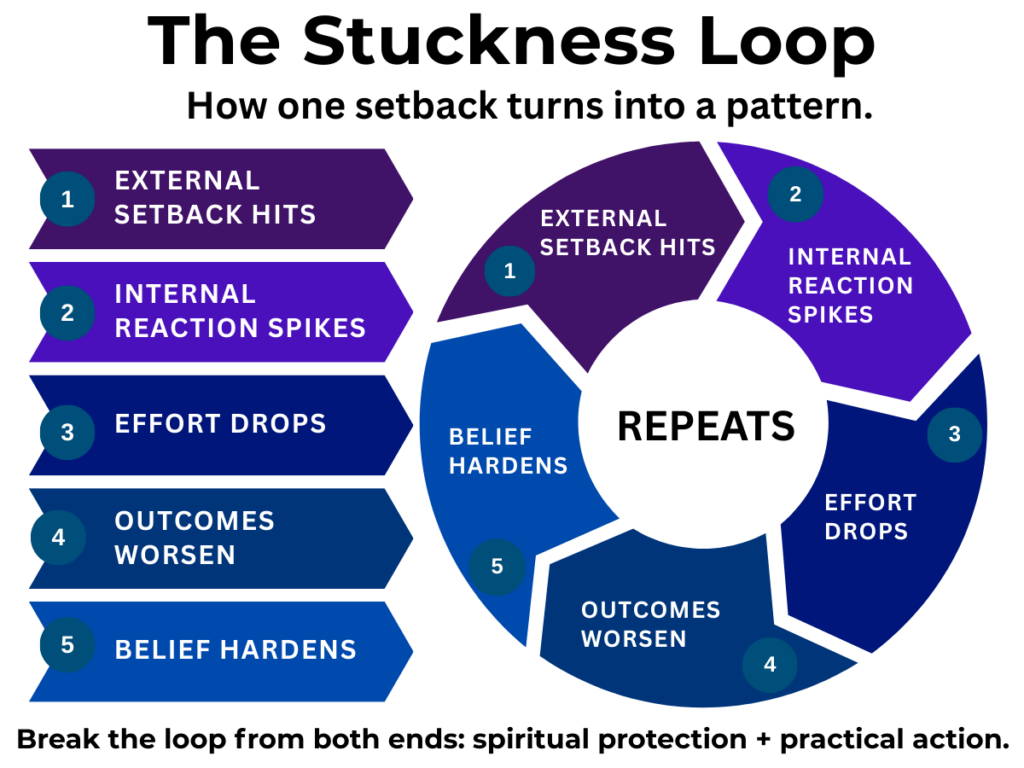
Most people think of spiritual affliction as something that happens to them from the outside. Events go wrong. Doors close. Opportunities collapse. And those things are real. But the external disruption is only half of how a blockage works.
Sihr, evil eye, and jinn attempt to shape the outside of your life, events, opportunities, other people’s reactions, while at the same time working on the inside of your life, your body, moods, thoughts, and self-belief. The blockage is created where those two lines meet.
The external layer is what people notice first. Proposals that disappear at the last moment. Business deals that collapse in bizarre ways. Paperwork that goes missing. Systems that crash at critical times. People who change their minds overnight with no explanation. Each incident, taken on its own, can be rationalised. Taken together over months or years, they form a pattern that feels engineered.
The internal layer is what makes the blockage stick. This is the part most people do not see clearly, because it feels like it is coming from inside them rather than being done to them. Every time the person sits down to work on the blocked area, something happens in their body or mind. Headaches arrive. Heaviness descends. Anxiety spikes. Foggy thinking rolls in. Sleepiness overwhelms them, even though they were alert five minutes ago doing something unrelated. And after every external setback, a thought lands: “What is the point? It will fail like last time. I am not capable. This is not written for me.”
The external layer pushes doors closed. The internal layer stops the person from pushing back. Together, they create what people experience as a locked life.
How a study block is engineered
Consider a student targeted so that their studies never move. On the external side, exams and projects are repeatedly derailed by last-minute chaos. Paperwork goes missing. Deadlines are missed through bizarre circumstances. Teachers and supervisors suddenly become obstructive and cold. Registration systems malfunction. Group projects fall apart at the final stage.
At the same time, the internal layer makes the blockage stronger and more believable. Every time the student sits down to study, they develop headaches, heaviness, or overwhelming sleepiness. They find they can focus easily on their phone or conversations, but their mind becomes foggy when they open a book. Just thinking about exams can bring a rush of anxiety or panic. After every setback, feelings of hopelessness and despondency kick in: “What is the point? I am clearly not meant for this.”
From the outside, observers see “procrastination” and “poor time management.” From the inside, the person feels as if studying has become a wall made of lead.
Now here is the part that makes the blockage so effective: the more the person internalises the idea that “I cannot do this” and “I am a failure,” the less effort they make. The less effort they make, the more “proof” the blockage seems to have. The sihr or jinn only need to give the initial push. After that, the person’s own nervous system and beliefs can start reinforcing the pattern until it looks purely psychological. The affliction gets the person to do its work for it.
How a marriage block is engineered
A marriage block can work in a similar way, whether the target is someone trying to get married or someone whose existing marriage is under attack.
For the person trying to get married, the external layer looks like proposals that disappear in bizarre ways. Families change their minds abruptly without explanation. Rumours and misunderstandings repeatedly ruin good matches at the last minute. Engagements collapse over trivial issues that somehow become insurmountable.
Internally and physically, the person may develop skin issues, weight changes, or other symptoms that affect their appearance and self-confidence. Waswas attacks their self-esteem: “You are ugly. No one will ever want you. You are broken. You are too old. You are too much or not enough.” Depressive thinking drains motivation to even try to meet anyone, and there is no energy left to push through the normal setbacks and disappointments that come with searching for a spouse.
The blockage works in two directions: it pushes away or disrupts external means, and it keeps the person emotionally on the floor so that even when a door opens, they are too discouraged, ashamed, or exhausted to walk through it.
Within an existing marriage, sihr of separation, evil eye, and jinn ‘ashiq can produce a different version of the same mechanism. Genuine affection and tranquillity may suddenly turn into coldness, baseless disgust, or hatred with no proportionate cause. One or both spouses lose desire specifically for each other while desire remains elsewhere. Constant irrational arguments erupt over trivial matters, especially around times of worship. A deep sense of being repelled from the spouse’s presence sets in without the person being able to explain why.
The internal layer compounds this. Each fight produces thoughts: “This marriage is finished. We are not compatible. I married the wrong person. Love is not written for me.” Those thoughts change behaviour. The spouses stop trying. They stop communicating. They stop being gentle. And the more they withdraw, the more evidence they accumulate that the marriage is indeed over. The sihr creates the pressure; the couple’s own reactions, driven by that pressure, finish the job.
Natural differences in temperament, unaddressed wounds, poor communication, and bad character can all damage a marriage without any spiritual cause. A mystical element becomes more likely when the negative shift was sudden and dramatic, when one or both spouses show clear reactions during ruqyah, and when multiple sincere attempts at normal reconciliation fail in a strangely repetitive, “blocked” way.
Allah mentions explicitly that sihr can target this bond:
فَيَتَعَلَّمُونَ مِنْهُمَا مَا يُفَرِّقُونَ بِهِۦ بَيْنَ ٱلْمَرْءِ وَزَوْجِهِۦ
“They learned from them that by which they cause separation between a man and his wife.”
(Al-Baqarah, 2:102)
How a work and money block is engineered
In many blockages, you will see the same two-layer combination targeting rizq and career. On the outside, every time a person saves money to start a business, an unexpected expense appears: the car breaks down, appliances fail, emergencies arise. Every time a project reaches the final stage, someone else sabotages it or systems fail in unlikely ways. Customers dry up despite consistent effort. Opportunities that were confirmed suddenly vanish.
On the inside, the person feels unusually lazy, foggy, or unmotivated exactly when it is time to work on their goals. Negative thoughts and emotions flood them at critical moments: “Why bother? It will fail like last time. I am not capable. People will laugh.” They procrastinate not because they do not care, but because something inside them has become convinced that effort is pointless, that this door will not open, that they are not the kind of person things work out for.
The external collapses feed the internal beliefs. The internal beliefs prevent the effort that might overcome the external obstacles. The loop tightens with each cycle.
The idea of a life being “tied up” is not foreign to the Qur’an. In Surah al-Falaq, Allah teaches us to seek refuge:
وَمِن شَرِّ ٱلنَّفَّـٰثَـٰتِ فِى ٱلْعُقَدِ
“And from the evil of those who blow upon knots.”
(Al-Falaq, 113:4)
Classically, these “knots” are understood as part of sihr rituals: knots tied and blown on to bind a particular aspect of a person’s life. In practice, that binding often appears as blockages in marriage, in work, in studies, in movement and decision-making. The external layer is the knot. The internal layer is what keeps you from untying it.
Why the loop is so hard to break from one side alone
The reason so many people stay stuck despite genuine effort is that they are only fighting on one front.
Some people focus entirely on the practical side. They push harder at work. They keep applying. They try to fix the marriage through communication and counselling. These are all good and necessary things. But if the spiritual source is still active, it keeps generating new pressure. New obstacles appear. New arguments erupt. The person makes progress and then watches it collapse again, because the engine behind the pattern has not been addressed.
Other people focus entirely on the spiritual side. They recite. They make du’a. They drink water. They wait for things to change. And they may feel some relief, some lightening. But the patterns of avoidance, fear, and collapse that the affliction installed in their thinking and habits do not disappear on their own just because the spiritual source weakens. Those patterns became grooves. The person keeps falling into them out of habit, even when the spiritual pressure has reduced.
This is why sihr, evil eye, and jinn do not usually create a completely new personality from nothing. They lean on what is already there: existing insecurities, old wounds, family patterns, and natural weaknesses in discipline, focus, or emotional regulation. They take what was a crack and turn it into a canyon. And even when the spiritual force is removed, the canyon remains until someone deliberately works to fill it.
Understanding this is critical for what comes next in this series. The affliction is a structure with two layers. Breaking it requires something that can reach the spiritual source, and it requires effort on the ground where the blockage is expressing. Neither alone is enough. Both together is how people actually recover.
The CBT and Islamic Healing series goes deep into the internal layer: how to identify the specific thought patterns the affliction has installed, how to challenge them, and how to stop your own mind from doing the blockage’s work for it. If you recognise the loop described in this post, that series gives you practical tools to interrupt it.
Reading patterns without paranoia
At this point, it can be tempting to read through everything above and start seeing blockages everywhere. That is not the goal.
Every human being will face setbacks and disappointments, experience sadness, anxiety, and intrusive thoughts, become ill, tired, and overwhelmed, and have bad dreams and relational conflicts. These are part of being alive. They do not automatically equal sihr, jinn, or evil eye.
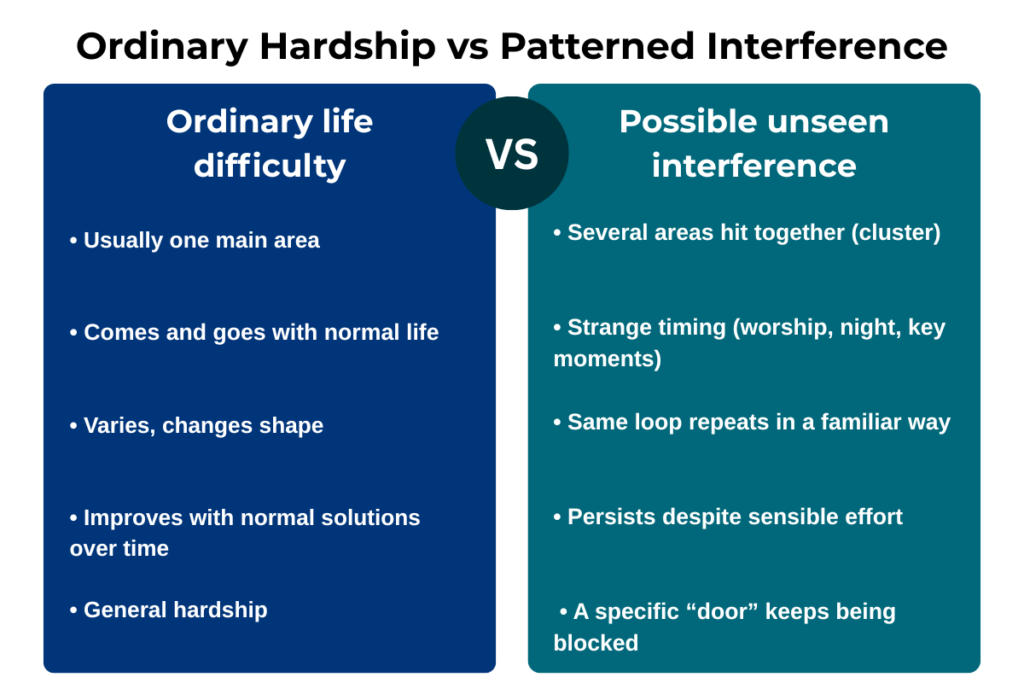
What often distinguishes a mystical component is not any single symptom, but the way problems braid together across multiple areas of life in patterns that feel targeted, repetitive, and resistant to normal solutions. The intensity often feels out of proportion to ordinary triggers. The timing is frequently tied to worship, Qur’an, du’a, or attempts to change for Allah’s sake. And the way problems behave under treatment is different: they may resist ordinary medical, psychological, and lifestyle interventions, yet react clearly to ruqyah and spiritual practices.
Even then, a mature reading does not usually say, “This is one hundred percent sihr and nothing else.” Rather, it sounds more like: “There are strong signs that unseen factors are interacting with my psychology, my body, and my life circumstances. I need to address all of these together.”
The principle we follow is simple: when in doubt, treat anyway. You do not need certainty before you begin. Ruqyah done with the right intention and within Sunnah boundaries is beneficial regardless of whether the cause is mystical, psychological, or both. And if there is a spiritual component present, the sooner you begin addressing it, the sooner the picture starts to clarify.
What breaks this machine
Now you can see that a blockage is not random bad luck. It is a structure. It has a spiritual source that generates pressure, and it has real-world footholds, in your body, your thinking, your emotions, your habits, that keep the pressure locked in place even when the person tries to push through.
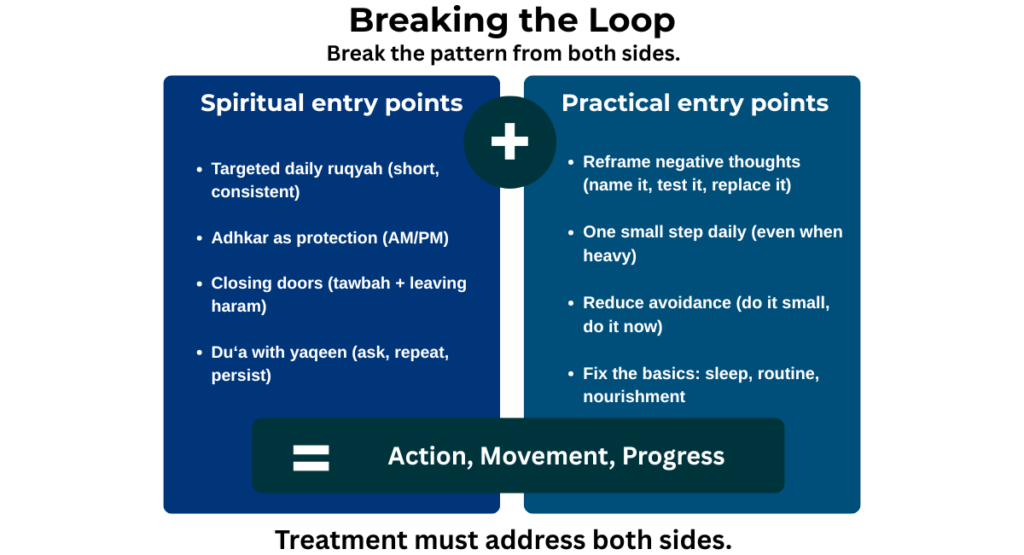
Breaking a structure like this requires something that can reach the source. Not positive thinking alone. Not willpower alone. Not medical treatment alone. Something that confronts the spiritual contracts and unseen causes directly.
That something is ruqyah: Qur’an and du’a used as treatment, within tawheed and clear Sunnah boundaries. Not amulets. Not jinn services. Not secret rituals. The words of Allah directed at the affliction with knowledge, intention, and consistency.
The next post explains exactly what ruqyah is, what it is not, and how it works as the core of healing.
What to do next
Assess your situation. If you have not yet assessed where the patterns are strongest in your life, the Am I Affected? page walks you through a structured self-assessment across six areas of your life with a diagnostic quiz that takes a few minutes.
Understand what you are dealing with. Each type of affliction has its own detailed guide:
- Signs of Evil Eye in Islam: How ‘Ayn and Hasad Actually Work
- Signs of Sihr in Islam: What Black Magic Actually Looks Like
- Signs of Jinn in Islam: How Jinn Interference Actually Works
Start treatment. The free 14-day self-ruqyah plan gives you a structured, Qur’an-based treatment method you can begin at home today. It is built on symptom-based recitation with specific intentions, not general Qur’an reading. No dependency on a practitioner. No ta’weez. No jinn services.
Break the internal loop. If you recognise the thought patterns described in this post, the CBT and Islamic Healing series gives you practical cognitive tools to interrupt them, within an Islamic framework.
Get personalised guidance. If you have been struggling for a while and need clarity on what you are dealing with or a targeted plan, find out how we can help.
Frequently Asked Questions
Can a blockage affect more than one area of life at once? Yes. In fact, this is one of the distinguishing features. A blockage rarely confines itself to a single domain. Someone dealing with marriage-related sihr, for example, often also reports sleep disturbance, emotional volatility, and difficulty in worship. The blockage works by engineering both external events and internal states simultaneously, which is why symptoms tend to cluster across several areas rather than appearing in isolation.
If the affliction leans on existing weaknesses, does that mean it is my fault? No. Every human being has insecurities, old wounds, and areas where they are less resilient. That is not a deficiency. It is the human condition. The affliction exploits what is already there, but the exploitation is not your doing. The fact that a crack existed does not mean you invited the force that turned it into a canyon. What matters now is addressing both the spiritual source and the real-world damage, without blaming yourself for being human.
How do I know if my “stuckness” is spiritual or just a normal rough patch? You may not need to choose. Normal rough patches and spiritual affliction can coexist. What raises concern is when the stuckness is persistent and targeted (the same area blocked repeatedly), when problems cluster across multiple domains at once, when the timing of setbacks correlates with worship or spiritual effort, and when normal solutions produce abnormally poor results. If you are unsure, the safest approach is to treat anyway. Ruqyah done correctly benefits the believer regardless of the cause.
Why do some people stay stuck even after starting ruqyah? Often because they are only addressing one layer. The ruqyah may be weakening the spiritual source, but the internal patterns, the avoidance, the negative beliefs, the emotional collapse, have become habits that continue running on their own. This is why treatment works best when recitation is combined with deliberate effort in the area of life that is blocked, and with tools to challenge the thinking patterns the affliction installed. The How to Unblock Your Life with Quran series covers how both tracks work together in practice.
Can children be affected by these blockages? Yes. Children living in afflicted environments may show signs: intense fear of the dark, night terrors, sudden behavioural shifts, regression in development, or unexplained physical symptoms. Children’s symptoms can be spiritual, emotional, developmental, medical, or a combination. If several children and adults in the same home are having parallel experiences, and those experiences respond to ruqyah and spiritual cleansing of the house, the home environment itself may need attention.
The Foundations Series
This post is part of the Foundations Series, which covers the core knowledge every Muslim needs about spiritual afflictions.
- Part 1: Sihr, Evil Eye, or Jinn: How to Tell the Difference
- Part 2: Signs of Evil Eye in Islam: How ‘Ayn and Hasad Actually Work
- Part 3: Signs of Sihr in Islam: What Black Magic Actually Looks Like
- Part 4: Signs of Jinn in Islam: How Jinn Interference Actually Works
- Part 5: How Sihr, Jinn, and the Evil Eye Create Blockages in Your Life (you are here)
- Part 6: What Is Ruqyah?
- Part 7: Treatment Tools That Support Ruqyah (Beyond Recitation)