
Learn what sihr actually is in Islam, the four core elements of black magic, how it reaches a person, what the signs look like, and what the Qur’an and Sunnah teach about protection and treatment.
Something in your life is blocked and you cannot explain why.
Marriage proposals keep falling through despite nothing being wrong with you. A business that should work keeps failing in ways that defy logic. Your relationship with your spouse has turned hostile or cold without any clear cause. Intimacy has disappeared. Fertility is blocked despite no medical explanation. You feel tied, stuck, as though an invisible wall is standing between you and the thing you are trying to reach.
You have tried the practical solutions. You have seen doctors. You have adjusted your approach. But the blockage does not move. It stays locked on the same area of your life, month after month, sometimes year after year.
If that pattern sounds familiar, sihr may be part of the picture.
Sihr (black magic, witchcraft) is one of the three doors of spiritual affliction confirmed in the Qur’an and Sunnah. Unlike the evil eye, which is typically sudden and unplanned, sihr is deliberate. Someone commissions it. A magician performs it. Jinn are sent to enforce it. And the harm is targeted at a specific person, relationship, or area of life.
This page covers what sihr actually is, how it works, the forms it takes, what the signs look like, and what the Qur’an and Sunnah teach about protection and response.
What sihr is
Scholars define sihr as a type of hidden, unusual effect that appears in the created world through specific statements or actions, usually involving cooperation with devils. It is not a label for “anything strange that happened.” Sihr is a deliberate, structured act of spiritual crime.
Allah describes it directly:
“They followed what the devils recited during the reign of Sulayman. Sulayman did not disbelieve, but the devils disbelieved, teaching people magic… And they learn from them that by which they cause separation between a man and his wife. But they do not harm anyone through it except by permission of Allah.” (Surah al-Baqarah, 2:102)
He commands us to seek refuge from those who practise it: “…from the evil of those who blow upon knots” (Surah al-Falaq, 113:4).
And the Prophet ﷺ said: “Whoever blows on knots has practiced magic, and whoever practices magic has committed shirk” (At-Tabarani).
Three things are established from these texts. The one who practises sihr has fallen into disbelief or major shirk. Sihr can cause real harm, including separation between husband and wife. And no matter how dark or powerful it appears, it never escapes the permission and control of Allah.
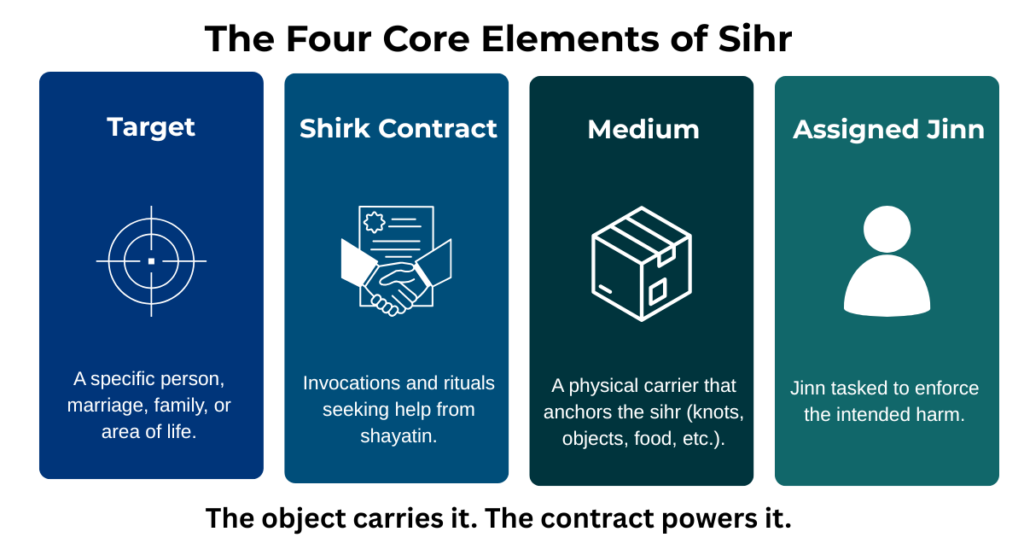
The four core elements of sihr
In practical ruqyah work, real sihr almost always involves four core elements working together.
A target. A specific person, couple, family, business, or aspect of life that the magician wants to affect.
Shirki invocations. This is the soul of the witchcraft. The magician calls upon “spirits,” “gods,” “saints,” “ancestors,” or “demons,” all of which are in reality shayatin responding to the call. The magician may use chants, mantras, written sigils, or texts containing shirk and kufr. They may perform acts of clear disbelief: insulting or desecrating the Qur’an, making offerings to other than Allah, prostrating to stars or idols, or writing Qur’anic verses in filth or reversed. This is the point at which the magician seeks help from shayatin instead of Allah. Without this core of shirk, we are not speaking about sihr in the sense described by the texts, no matter how strange or “energetic” something feels.
A medium. The physical “container” that carries and anchors the sihr. This can be knots and threads, powders, liquids or oils, buried or hidden objects, food, drink, clothing, hair, nails, personal items, paper, dolls, or effigies.
Jinn assigned to enforce it. In response to the shirk and rituals, shayatin accept the “contract,” attach themselves to the target, and begin pushing the person’s life, thoughts, emotions, and circumstances toward the intended harm.
At the heart of sihr is not the knot, the powder, or the doll. The central crime is the magician turning to and beseeching from the shayatin. Everything else grows out of that core act of shirk.
How to recognise the signs of sihr
Before we look at the different forms sihr can take, it helps to understand the general pattern that distinguishes sihr from other types of spiritual affliction.
Persistence and specificity. Sihr tends to hammer one area of life relentlessly. It does not scatter across random problems. Marriage is blocked and every prospect fails. A business keeps collapsing in ways that make no sense. Intimacy between spouses disappears. The blockage stays locked on its target, often for years, and it does not drift.
Resistance to treatment. Many people dealing with sihr notice that things worsen specifically around acts of worship or when they begin ruqyah treatment. The affliction pushes back. Motivation to recite drops. Obstacles appear every time you try to be consistent. This defensive quality is one of the markers that something is actively working against you, not just passive bad fortune.
A person with motive and timing. Sihr is commissioned. In many cases, there is someone in the picture who had a reason: a jealous relative, a rejected suitor, a business rival, a hostile in-law. This does not mean you should start accusing people. But if the pattern of harm aligns with a specific person’s motive and timing, it is worth noting as part of the broader picture.
Symptoms that do not respond to normal explanations. Doctors find nothing wrong, or treat what they see with limited success. The problem behaves strangely: it flares during spiritual weakness and eases during strong worship, it is cyclical or patterned, or it appeared suddenly without any medical or psychological trigger.
For a broader comparison of how sihr differs from the evil eye and jinn interference, read Sihr, Evil Eye, or Jinn: How to Tell the Difference.
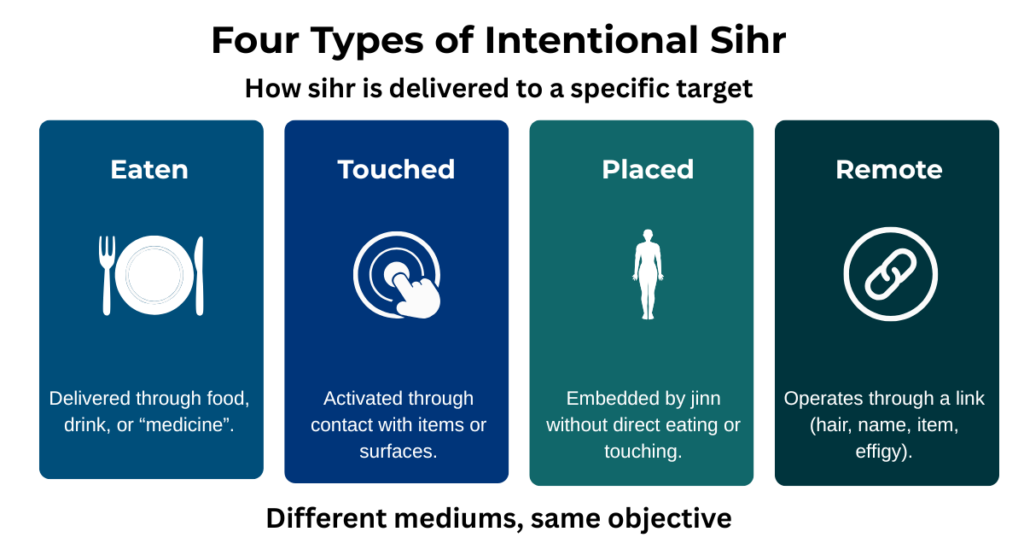
The four forms of intentional sihr
The Qur’an does not give a technical manual of every method used, and techniques vary across cultures. But practitioners have observed common patterns in how sihr reaches a person. One practical way to classify sihr is by its delivery method. From this angle, there are four main forms of intentional sihr, and two forms of secondary or unintentional exposure.
Eaten sihr
The sihr is prepared so that the victim consumes it. It may be mixed into food, dissolved into a drink, disguised as “medicine,” or sprinkled onto something that will be tasted. The sihr enters the digestive system, and jinn tasked with enforcing it cause it to settle at some point along the tract.
Because the medium is now inside the body, two layers of effects often appear. The first is the intended goal: blocking marriage, destroying appetite for Qur’an, tying a person away from their spouse, blocking rizq. The second is a cluster of side effects related to the digestive system: pain or cramps, indigestion, heartburn, diarrhoea or constipation, bloating, gas, nausea, and fluctuation between these states.
These digestive symptoms may be diagnosed medically as IBS, functional bowel disorders, or even inflammatory conditions like Crohn’s disease or ulcerative colitis. Medicine will treat what it can see. The important thing is to keep both perspectives together: medical investigation and treatment must not be abandoned, but if the patterns are strange, stubborn, or strongly linked to spiritual signs and ruqyah reactions, sihr may be one of the unseen causes feeding the condition. The digestive problems are often “smoke from the fire,” not the main target.
Touched sihr
This is sihr that activates through physical contact. The victim does not ingest anything. Instead, the sihr is thrown or sprayed onto them, placed where they will step on it, or put onto clothing, bedding, towels, hijabs, jewellery, gifts, or objects they frequently handle.
Physically, this can result in pain or heaviness in the body part that made contact, persistent skin problems at that area (rashes, strange wounds, itchiness, eczema or psoriasis-like patterns that resist treatment), and sensations of burning, crawling, or stabbing without clear medical explanation. These physical symptoms may co-exist with genuine dermatological conditions, and medical assessment is still necessary.
The intended spiritual effect is often broader than the local skin reaction: creating fear or anxiety, tying a person’s hands in their work, isolating them socially, or causing them to avoid certain places or people. The skin reaction is the footprint showing that something was activated through contact.
Sihr placed inside the body by jinn
In this case, the victim may not eat or touch anything unusual at all. The magician performs the ritual, jinn are sent directly to the person, and those jinn place or embed the sihr inside specific areas of the body.
Common targets include the womb (to block conception, cause repeated miscarriage, or create chronic gynaecological issues), the sexual organs (to cause impotence, inability to be intimate, or aversion), the head (to create confusion, forgetfulness, mental fog, severe headaches, or inability to focus and learn), and the chest (to cause tightness, constant anxiety, panic-like symptoms, or aversion to Qur’an and salah).
Doctors may find no clear cause, or may treat what they see with limited success. From a ruqyah perspective, you will often see strong reactions during recitation focused on the affected area, sensations of movement, pressure, or heat in that region, and symptoms that shift under ruqyah but then try to return. The mature approach is to carry out medical checks and follow treatment where needed, while recognising that sihr placed by jinn can be one of the hidden reasons why certain dysfunctions resist normal treatment and behave in a very patterned way.
Sihr at a distance (symbolic or linked sihr)
In this type, the person does not directly eat or touch anything. The sihr operates remotely, using a link: the person’s name, hair, nails, clothing, personal items, photos, signatures, or an effigy made to represent them. The magician uses symbols and actions that stand in for what they want to happen. Tying knots to symbolise blocking or strangling part of the person’s life. Locking a padlock and burying it to represent a locked marriage, womb, career, or rizq. Burying sihr in a graveyard to represent the “death” of a relationship, project, or opportunity.
Because much of this happens away from the victim, effects seem to come from nowhere. Problems may not respond to changes in environment or lifestyle because the physical sihr remains anchored elsewhere.
Ruqyah practitioners often note that this type of sihr can show itself in dreams that reflect the symbolism used. Sihr buried in a cemetery may be accompanied by dreams of funerals, graves, dead bodies, or the death of loved ones. Sihr with knots may show up as dreams of snakes, ropes, chains, or strangling. Dreams on their own are never proof, but when they align with symptoms and ruqyah reactions, they can be clues to the type of sihr at work.
Unintentional exposure: sihr that was not meant for you
Not every case of sihr affecting someone was targeted at them directly. There are situations where sihr affects people it was never designed for.
Inherited effects
When a mother is under sihr before or during pregnancy, practitioners observe that elements of the affliction can affect the unborn child. This can happen in two overlapping ways. The first is a more direct spiritual effect: the sihr and jinn are already strongly attached to the mother, and the child grows in an environment where these influences are present from the earliest stages of life. The second is an indirect environmental effect: a home where one or both parents are afflicted often has more jinn activity, more conflict, fear and instability, and more neglect of protection when the parents are overwhelmed.
Children raised in such environments may experience more frequent illness or weak health when young, show strong emotional reactivity or anger as they grow older, be more sensitive to jinn interference and fear at night, or show early signs of spiritual disturbance. This does not mean the child is cursed or doomed. It means that sihr on parents can increase the spiritual vulnerability of children, and that early protection, ruqyah, and healthy parenting become even more important.
Accidental consumption or contact
A person may consume or touch sihr that was prepared for someone else entirely. Food prepared for one person may be shared by many. An item carrying sihr may pass through different hands. Sihr may be hidden in a common area such as a workplace, masjid, or student residence.
In such cases, the link between the sihr and its intended target is weak or absent for the bystander. What often appears is side effects related to the form of sihr (digestive problems for eaten sihr, skin issues for touched sihr) but not the full intended psychological or life-damaging effects. With ruqyah and purification, the grip often loosens more easily than it would for the intended target.
How sihr interacts with the rest of your life
Regardless of the delivery method, the goals behind sihr are often similar: separation between spouses, blockages in marriage or work or study, forced attachment or obsession, chronic illness, and general destruction of stability.
But sihr does not operate in a vacuum. It interacts with the victim’s spiritual state (strength or weakness in salah, adhkar, tawbah, and tawakkul), their habits (persistent sins that open doors to shayatin, or protective routines that limit access), their environment (a home filled with Qur’an, modesty, and order, or a home filled with neglect, shouting, and chaos), and their physical and psychological vulnerabilities.
This is why two people can be hit by similar sihr but experience it very differently. Sihr is one layer. The rest of the person’s life and iman either weakens or strengthens its impact.
Protection from sihr: what the Qur’an and Sunnah teach
Islam does not leave a believer exposed to sihr. The Qur’an teaches us to seek refuge from it explicitly, and the Sunnah provides daily protections that are simple, consistent, and free of superstition.
Morning and evening adhkar. Your daily shield. Consistency matters more than intensity. A short routine done every day is more protective than a long session done once and then forgotten for a week.
Surah al-Falaq. This surah is directly relevant to sihr. Allah explicitly commands us to seek refuge from “those who blow upon knots” (113:4). Recite it as part of your daily adhkar and before sleep.
Ayat al-Kursi and the last verses of Surah al-Baqarah. Core protections from shaytanic harm, especially at night. Work them into your routine after salah and before sleep.
The comprehensive prophetic du’a. “A’ūdhu bi kalimātillāhi at-tāmmāti min sharri mā khalaq” (I seek refuge in the perfect words of Allah from the evil of what He has created). Short, easy, and covers all created harm including sihr.
Keep your home spiritually clean. Many sihr cases are reinforced by shaytanic presence in the home. Consistent Qur’an recitation, regular salah, and reducing what brings spiritual darkness into the space all make the home less hospitable to the jinn assigned to enforce the sihr.
For a detailed breakdown of daily protection practices, including specific du’as for children and family members, read Signs of Evil Eye in Islam, which covers the full Sunnah-based protection routine in depth.
If you suspect sihr
If you recognise these patterns in your life, the response is grounded and practical.
Assess your situation. The diagnostic quiz walks you through a structured self-assessment across six areas of your life. It takes a few minutes and surfaces patterns you may have been explaining away individually but that form a clearer picture when seen together.
Start treatment. The free 14-day self-ruqyah plan gives you a structured, Qur’an-based treatment method you can begin at home today. It is built on symptom-based recitation with specific intentions, not general Qur’an reading. You recite for the specific blockage or symptom you are experiencing, with a targeted intention, alongside practical real-world effort. No dependency on a practitioner. No ta’weez. No jinn services.
Get personalised guidance. If you have been treating for a while and the pattern is complex, layered, or resistant, find out how we can help with a diagnostic assessment that identifies the type of affliction and a personalised treatment plan built around your specific situation.
Frequently Asked Questions
How do I know if it is sihr or just bad luck? Sihr tends to show as a persistent, targeted blockage in a specific area of life rather than scattered misfortune. The problem stays locked on its target, often for years. It may resist normal solutions, worsen around worship or treatment, and align with the motive and timing of someone who had reason to commission harm. General “bad luck” tends to be more diffuse and responds to practical changes. If the pattern is persistent, specific, and resistant, sihr is worth considering alongside other explanations.
Can sihr affect someone who prays regularly? Yes. The Prophet ﷺ himself was affected by sihr, and he was the most devout human being who ever lived. Regular worship provides powerful protection and can reduce the severity and duration of sihr, but it does not guarantee immunity. Salah and adhkar are armour on the battlefield, not a ticket out of the battlefield.
Can sihr cause physical illness? Yes. Depending on the form, sihr can produce digestive symptoms (eaten sihr), skin problems (touched sihr), reproductive issues, headaches, chest tightness, and other physical effects. These may co-exist with genuine medical conditions, and medical investigation should not be abandoned. When symptoms are stubborn, patterned, linked to spiritual signs, and do not respond to normal treatment, sihr may be one of the hidden causes.
Can you have sihr done on you without knowing? Yes. Many people live with the effects of sihr for years without recognising what it is. They attribute the blockage to bad luck, personal failings, or unexplained medical issues. The sihr itself often has a defensive quality: it can suppress the person’s motivation to seek treatment, create doubt about whether anything spiritual is happening, and generate resistance every time they try to address it.
Is it possible to accidentally consume or touch sihr meant for someone else? Yes. Food prepared for one person may be shared by others. Items carrying sihr may pass through different hands. In such cases, the person typically experiences side effects related to the form of sihr (digestive issues, skin reactions) but not the full intended effect, because the sihr was not bound to them. These cases often respond to ruqyah and purification more readily than targeted sihr.
The Foundations Series
This is Part 3 of the Foundations Series, covering the Islamic foundations of spiritual affliction and healing.
- Part 1: Sihr, Evil Eye, or Jinn: How to Tell the Difference
- Part 2: Signs of Evil Eye in Islam: How ‘Ayn and Hasad Actually Work
- Part 3: Signs of Sihr in Islam: What Black Magic Actually Looks Like (you are here)
- Part 4: Signs of Jinn in Islam: How Jinn Interference Actually Works
- Part 5: How Sihr, the Jinn and Evil Eye cause Blockages in Your Life
- Part 6: What Is Ruqyah?
- Part 7: Treatment Tools That Support Ruqyah