
Learn what jinn interference looks like in Islam, the three levels from waswas to possession, why jinn target people, and how to respond without fear or obsession.
You wake up often at night, pressed down, unable to move, sensing a presence in the room. Nightmares repeat with the same themes. You feel drained in the morning no matter how many hours you slept. The house feels heavy, especially at night. You feel presences when you’re alone and sometimes see fast moving shadows.
Or maybe it is the mood. Sudden rage that does not match the situation. Aversion to Qur’an that you cannot explain. A personality shift that others notice before you do. A pull toward sins or self-destructive behaviour that feels disproportionate to who you actually are.
Or perhaps the thoughts will not stop. Not the ordinary kind that everyone deals with, but something heavier. Doubts about your faith that feel planted rather than natural. A voice in your own head that sounds like yours but says things you would never say. Intrusive images during salah. Blasphemous thoughts that fill you with horror and guilt, even though you never chose them.
If any of this sounds familiar, jinn interference may be part of the picture.
Jinn interference is the third of the three doors of spiritual affliction confirmed in the Qur’an and Sunnah, alongside the evil eye and sihr. It covers a wide spectrum, from the universal experience of waswas (whispering) that every human deals with, through increasing levels of influence and disturbance, up to partial or full possession at the extreme end. Most cases fall somewhere in the middle, and the response Islam teaches is grounded, practical, and free of the drama and fear that surrounds this topic in many communities.
What jinn are
Jinn are a real, invisible creation of Allah, made from smokeless fire. They live, marry, have offspring, and die. They eat and drink. They are obligated to worship Allah and will be judged on the Day of Resurrection. Among them are believers and righteous individuals, disbelievers and hypocrites, and devils (shayatin) who specialise in misguiding and harming human beings.
Allah says: “And the jinn We created before from scorching fire” (Surah al-Hijr, 15:27). And He says: “Indeed, he [Shaytan] sees you, he and his tribe, from where you do not see them” (Surah al-A’raf, 7:27).
Classical scholars of Ahl al-Sunnah affirm that jinn can possess humans, influence them, and speak through them. This is not a fringe belief. It is established by both experience and authentic texts.
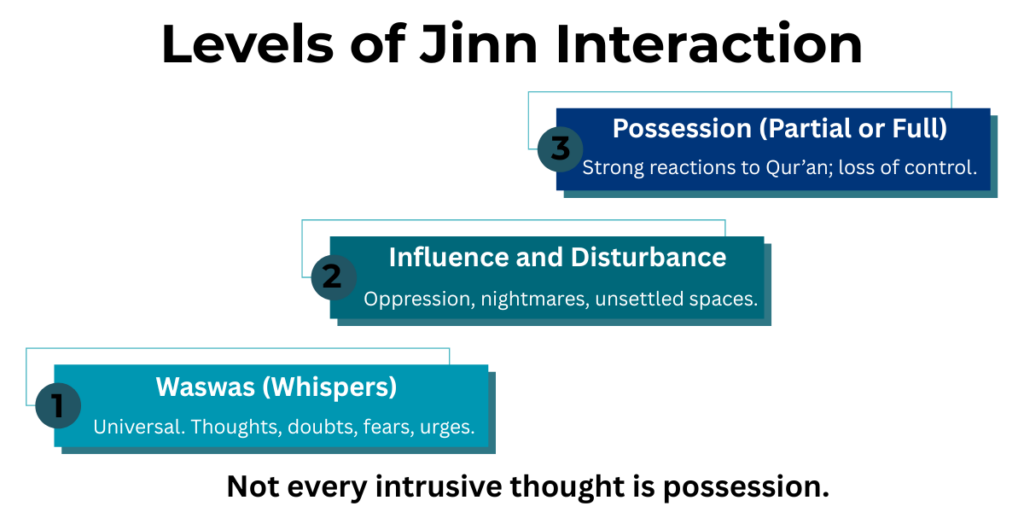
The three levels of jinn interference
Jinn interaction with humans runs on a spectrum. Understanding where you fall on that spectrum matters, because the response is different at each level.
Level 1: Waswas (whispering)
This is the most basic level, and it is universal. Every human being experiences waswas. Shaytan suggests thoughts, doubts, fears, and desires. He tries to colour how you interpret events, how you think about Allah, and how you see yourself and others.
Not every intrusive thought is a sign of jinn possession. Most of the time, waswas is “standard issue” spiritual interference that every person faces as part of the human condition. It needs spiritual tools (adhkar, Qur’an, tawbah) and often psychological tools as well (recognising thought patterns, not engaging with every thought that appears, understanding the difference between a thought and a belief). The CBT and Islamic Healing series covers this in depth, including how to identify and challenge the thinking patterns that waswas exploits.
The line between ordinary waswas and something deeper is not always sharp, but there are markers. When waswas is persistent beyond what is normal, when it targets specific areas with unusual intensity (especially faith, marriage, or worship), when it is accompanied by other signs from the levels below, or when it does not respond to the usual spiritual and psychological tools, it may indicate that something more than baseline shaytan is at work.
Level 2: Influence and disturbance without full possession
At this level, a person may sense a presence in the home: noises, movements, shadows, a feeling of being watched. They may suffer recurring nightmares, sleep paralysis, or a sense of oppression at night. They may experience heavy mood swings or agitation at particular times or in particular places, especially around acts of worship. They may feel driven toward certain sins or forms of self-destructiveness that seem disproportionate to their usual character.
This level is more than ordinary waswas but less than possession. The person is still themselves. They have not lost control. But something is pressing on them from the outside, affecting their inner world in ways that go beyond what normal stress or psychology would explain.
Many people live at this level for years without recognising it. They attribute the mood swings to personality, the sleep disturbance to stress, the spiritual heaviness to weak iman. The patterns only become visible when someone learns what to look for.
Level 3: Partial or full possession
At the most severe end of the spectrum, there may be strong physical reactions during Qur’an recitation: shaking, screaming, collapsing, changes in voice or facial expression. A person may enter states in which they later have no memory of what they said or did. In some cases, a jinn may speak through them when confronted during ruqyah, sometimes revealing how and why it came, or threatening further harm.
We see reflections of these realities in authentic narrations. A boy was repeatedly seized by fits, and his mother brought him to the Prophet ﷺ, who commanded the unseen being to leave in Allah’s name. The boy was cured.
Full possession is the extreme end of the spectrum. It gets the most attention in ruqyah communities, but it is not the most common presentation. Far more people are dealing with Level 1 or Level 2 interference than with full possession.
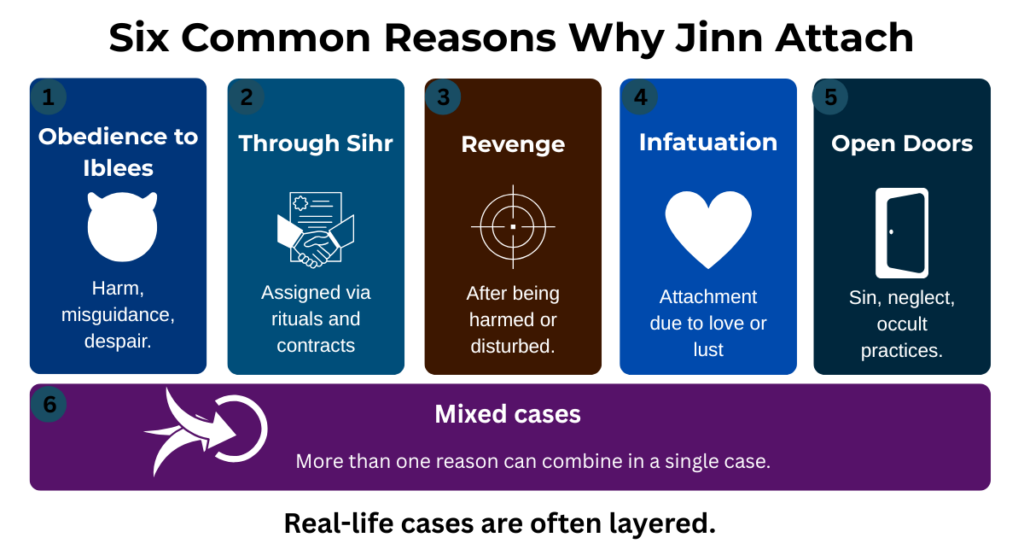
Why jinn target people
From experience and texts, several common reasons emerge.
Obedience to Iblees. Some jinn harm humans simply because that is what they do. They follow orders, enjoy causing misguidance and despair, and target believers specifically because disrupting worship and family life is what Shaytan rewards.
Hired through sihr. This is one of the most common reasons. A magician performs a ritual involving shirk, and jinn are sent to enforce the instructions of the magic against a specific target. In these cases, the jinn interference is a symptom of the sihr, not a standalone problem. For more on how this works, read Signs of Sihr in Islam.
Revenge. A jinn may attach itself to a person after being harmed, whether deliberately or accidentally. The jinn retaliates by attaching to the person or their family.
Infatuation (jinn ‘ashiq). A jinn becomes attached to a person’s beauty, voice, character, or even their sins, and “claims” them. This type of jinn actively interferes with marriage and intimate relationships. It may cause aversion between spouses, prevent marriage proposals from succeeding, or create disturbing dreams of a sexual nature. Jinn ‘ashiq cases are often long-standing and can predate the person’s marriage, meaning the interference was present from day one rather than appearing as a sudden change.
Openings created by sin and neglect. Certain environments and lifestyles create easy access for shayatin. Persistent major sins, involvement with the occult (fortune-telling, séances, horoscopes, “energy healing” that invokes other than Allah), and complete neglect of salah and adhkar all signal that the spiritual defences are down. Shayatin do not need dramatic “hauntings” when they can simply move in through open doors.
Generational pacts. When a person decides to work with jinn, whether through magic or other forms of shirk, they typically enter into pacts with the jinn and in most cases make some kind of offering or sacrifice. The jinn take those pacts seriously and will uphold them not just with the original person, but with their descendants. This is the critical point: if anywhere in your lineage, whether on your mother’s side, your father’s side, or even ten generations back, an ancestor entered into these kinds of pacts, you can be affected by them today.
What the jinn generally want from the descendants is the same thing they got from the original pact-maker: shirk and offerings. To accomplish this, they will harass and afflict the descendant in the ways jinn normally affect people, but with a specific strategic aim. They push you toward using methods of shirk to resolve the problems you are experiencing in life. In other words, they create the suffering, and then they steer you toward the haram “solution.” This is how many magicians become magicians. The path was laid before they were born.
Generational pacts are also one of the very common root causes behind persistent witchcraft issues that seem to follow a family across generations. The jinn instigate and inspire people against you throughout your life so that you are affected repeatedly and your life becomes deeply stuck. Along with inherited affliction from a mother who was under sihr during pregnancy, generational pacts are one of the most common explanations for jinn ‘ashiq (love/lust jinn) cases, where the interference appears to have been present from the very beginning of a person’s life rather than arriving at a specific point.
In practice, cases are often mixed. A jinn may originally come through sihr or generational pacts and later develop its own attachment or hatred. One may come for revenge and then be recruited into enforcing magic. The categories help with understanding, but real cases do not always fit neatly into a single box.
Jinn interference or mental health?
This is one of the most important questions in this space, and it deserves a careful answer.
Many of the signs associated with jinn interference overlap with recognised psychological and psychiatric conditions. Intrusive thoughts are a hallmark of OCD. Sleep paralysis has well-documented neurological explanations. Hearing voices, personality shifts, and dissociative episodes can be symptoms of schizophrenia, PTSD, dissociative disorders, or other conditions. Sudden mood changes can be bipolar disorder, hormonal imbalances, or trauma responses.
The honest position is that both realities exist. A person can have a genuine psychiatric condition that needs clinical treatment. A person can have genuine jinn interference that needs ruqyah. And a person can have both at the same time, with each one feeding the other.
What distinguishes jinn-related signs from purely psychological ones is not any single symptom, but the broader pattern. Jinn interference tends to show alongside other spiritual markers: reactions during Qur’an recitation (heat, pressure, nausea, agitation, involuntary movement), symptoms that worsen around worship and ease when worship is neglected, disturbing dreams with recurring themes (snakes, dogs, dark figures, being chased, sexual content), a noticeable shift in the home atmosphere, and multiple family members being affected rather than just one person.
If the symptoms are purely psychological in character and respond to clinical treatment, there may be no spiritual component. If they are accompanied by clear spiritual markers and do not respond to clinical treatment alone, jinn interference is worth considering. If both patterns are present, pursue both avenues: clinical support for the medical and psychological layers, ruqyah for the spiritual layer. These are not competing approaches. They address different dimensions of the same person.
The one thing to avoid is the extreme on either side: dismissing everything as “just anxiety” when clear spiritual signs are present, or labelling everything as jinn when someone urgently needs psychiatric care. Both extremes cause real harm.
Protection from jinn interference
The Sunnah teaches daily protection that is simple, consistent, and free of drama. The full protection routine (morning and evening adhkar, the Mu’awwidhat, Ayat al-Kursi, the last two verses of Surah al-Baqarah, and the comprehensive du’a of protection) is covered in detail in Signs of Evil Eye in Islam. Everything in that routine applies here. Rather than repeating it, this section focuses on protections that are particularly relevant to jinn interference specifically.
Surah al-Baqarah in the home
A home where Surah al-Baqarah is recited or played regularly is not the same as a home filled only with noise. This is one of the most practical household protections taught in the Sunnah against shayatin settling in a space. If you are experiencing disturbance in the home, heaviness at night, or a sense of presence, make Surah al-Baqarah a regular feature. Even playing it respectfully when household members cannot recite it themselves is a step in the right direction.
Protect your transitions
Many people experience spikes of waswas and disturbance at specific transition points: before sleep, on waking, entering the bathroom, entering the home, before intimacy, and when anger rises. The Sunnah gives specific adhkar for each of these moments. These are not optional extras. They are targeted protections for the moments when shayatin are most active. Consistency at these transition points often reduces the “night pressure” and the feeling of being harassed or followed.
Keep your home spiritually clean
If you want a calm home, remove what feeds the opposite. Persistent haram content, aggressive arguments, and neglect of salah all create an environment that shayatin thrive in. A home with regular salah, Qur’an, and basic adab becomes difficult ground for them. This is not superstition. It is a practical application of the principle that spiritual protection works in layers, and the home environment is one of those layers.
If you suspect jinn interference
If you feel you are dealing with more than ordinary waswas, the response is grounded and practical.
Assess your situation. If you are unsure whether what you are experiencing has a spiritual component, the diagnostic quiz walks you through a structured self-assessment across six areas of your life.
Start treating yourself. The free 14-day self-ruqyah plan gives you a structured method you can begin at home today. It covers what to recite, how to recite it, what intentions to set, and how to combine spiritual treatment with practical effort.
Understand what you might be facing. Each of the three doors of spiritual affliction has its own detailed guide:
- Signs of Evil Eye in Islam: How ‘Ayn and Hasad Actually Work
- Signs of Sihr in Islam: What Black Magic Actually Looks Like
- Signs of Jinn in Islam: How Jinn Interference Actually Works
Get personalised guidance. If you have been treating for a while and need help identifying what you are dealing with or building a targeted plan, find out how we can help.
Frequently Asked Questions
Can jinn cause anxiety and depression? Jinn interference can produce symptoms that look like anxiety and depression: persistent low mood, dread, inability to function, panic-like episodes, and a heaviness that does not lift. Whether the jinn are the primary cause, a contributing factor, or not involved at all depends on the broader pattern. If the mood symptoms are accompanied by spiritual markers (reactions during Qur’an, disturbed sleep with recurring themes, worsening around worship, a home atmosphere that others notice), jinn interference is worth considering alongside clinical assessment. Pursue both avenues rather than choosing one and ignoring the other.
Is every intrusive thought a sign of jinn? No. Intrusive thoughts are a normal part of human psychology. Everyone experiences unwanted or disturbing thoughts at some point. In clinical terms, this is well-documented in OCD, anxiety disorders, and trauma responses. Waswas from Shaytan is also universal and does not indicate possession. The distinction matters: ordinary waswas responds to adhkar, tawbah, and cognitive tools. When the thoughts are persistent beyond what is normal, target specific areas with unusual intensity, and are accompanied by other spiritual signs, something deeper may be present. But the default assumption should not be possession every time an unpleasant thought appears.
Can jinn cause problems in marriage? Yes. Jinn can interfere with marriages in several ways. If they are sent through sihr, they may actively work to create hatred, misunderstanding, and separation between spouses. If a jinn ‘ashiq is attached, it may cause aversion to the spouse, interfere with intimacy, and sabotage any potential for closeness. Even baseline jinn influence can amplify existing tensions, fuel waswas about the spouse, and make minor disagreements feel catastrophic. For more on the overlap between sihr and marriage problems, read Signs of Sihr in Islam.
How do I know if it is jinn or a mental health condition? You may not need to choose. Both can be present simultaneously. The practical approach is to look at the broader pattern. If the symptoms are accompanied by clear spiritual markers (reactions during recitation, symptoms worsening around worship, disturbing dreams with recurring themes, a heavy home atmosphere), pursue ruqyah alongside clinical support. If the symptoms are purely psychological and respond to clinical treatment, there may be no spiritual component. The one thing to avoid is the extreme on either side: dismissing everything as medical when clear spiritual signs are present, or labelling everything as jinn when someone needs professional psychiatric care.
Can jinn be present from birth? Yes. In cases of jinn ‘ashiq, generational pacts (where ancestors entered into agreements with jinn through shirk), or inherited affliction (where the mother was under spiritual affliction during pregnancy), jinn interference can be present from the earliest stages of life. In such cases, there may not be a clear “before and after” moment. The person may have always experienced certain patterns (difficulty in relationships, a persistent sense of heaviness, strong reactions to Qur’an from a young age) without ever identifying them as unusual because they had no baseline to compare against.
Can spiritual affliction run in families? Yes, and this is more common than many people realise. If an ancestor entered into pacts with jinn through sihr or other forms of shirk, those jinn may continue to enforce those pacts across generations, targeting descendants to push them toward the same shirk. This is one of the hidden reasons why some families seem to have a pattern of spiritual problems, failed marriages, stagnation, or repeated encounters with magicians and “healers” who use haram methods. The jinn create the problems, and then steer the person toward haram solutions. Recognising this pattern is the first step to breaking it. Treatment through Qur’an-based ruqyah addresses the jinn directly without repeating the shirk that the pact was built on.
What is the difference between epilepsy/seizures and jinn possession? Both are real. Epilepsy is a well-documented neurological condition with identifiable patterns, and it requires medical treatment. At the same time, authentic narrations describe seizure-like episodes caused by jinn interference, including the boy brought to the Prophet ﷺ who was repeatedly seized by fits and cured when the Prophet ﷺ commanded the jinn to leave. The two can look similar on the surface, and in some cases both may be present in the same person. The practical approach is the same as with mental health: pursue medical investigation and treatment for the neurological condition, and if the episodes are also accompanied by spiritual markers (reactions during Qur’an recitation, patterns that do not fit the medical diagnosis, worsening around worship), address the spiritual layer through ruqyah as well. Never stop someone’s epilepsy medication because you suspect jinn, and never dismiss the possibility of jinn because there is a medical diagnosis.
The Foundations Series
This is Part 4 of the Foundations Series, covering the Islamic foundations of spiritual affliction and healing.
- Part 1: Sihr, Evil Eye, or Jinn: How to Tell the Difference
- Part 2: Signs of Evil Eye in Islam: How ‘Ayn and Hasad Actually Work
- Part 3: Signs of Sihr in Islam: What Black Magic Actually Looks Like
- Part 4: Signs of Jinn in Islam: How Jinn Interference Actually Works (you are here)
- Part 5: What Sihr, Evil Eye, and Jinn Can Affect in Your Life
- Part 6: What Is Ruqyah?
- Part 7: Treatment Tools That Support Ruqyah