
Not sure whether you’re dealing with sihr, evil eye, or jinn? Learn how Islam distinguishes the three, what each one looks like, and what to do next.
Something is wrong and you cannot explain it. Life has stalled, your health has shifted, your marriage is under pressure, your sleep is broken, or a heaviness has settled over you that no amount of rest seems to lift. You have tried the obvious explanations. You have seen doctors, adjusted your routine, made du’a. But the pattern keeps repeating, or nothing quite adds up.
At some point the question surfaces: could this be something spiritual?
If you are asking that question, the next one is usually harder. Is it sihr (black magic)? The evil eye? Jinn? How do you tell the difference? And does it even matter which one it is?
Islam does not leave you guessing. The Qur’an and Sunnah give us a clear framework: three distinct pathways through which unseen harm can reach a person, each with its own mechanism, its own patterns, and its own response. Understanding the difference is not about obsessing over labels. It is about knowing where you stand so you can take the right next step.
The three doors of unseen harm
Almost every genuine case of spiritual affliction connects to one or more of three categories. These are not cultural inventions or folk beliefs. Each one is named, described, and addressed in revelation.
‘Ayn (the evil eye) is harm that travels through a person’s gaze or heart, by Allah’s permission, when envy, jealousy, or even unguarded admiration strikes a blessing in someone else’s life. It can affect health, appearance, wealth, relationships, children, careers, and even aspects of deen. The Prophet ﷺ said that the influence of the evil eye is real, and that if anything were to precede the Divine Decree, it would be the evil eye (Sahih Muslim).
Sihr (black magic / witchcraft) is a deliberate, structured act of spiritual crime. A person commissions a magician, who performs rituals involving shirk, calls upon shayatin, and sends them to enforce a specific instruction against the target. Sihr is not vague bad energy. It has a commissioner, a method, a medium, and an intended result. Allah describes it directly in Surah al-Baqarah (2:102), including that it can cause separation between husband and wife.
Jinn interference covers the range of harm that comes through the actions and presence of jinn themselves. This can be as subtle as persistent waswas (whispering) and as severe as partial or full possession. Jinn may interfere out of obedience to Iblees, as enforcers of sihr, out of revenge, out of infatuation, or simply because a person’s spiritual defences have weakened enough to create an opening.
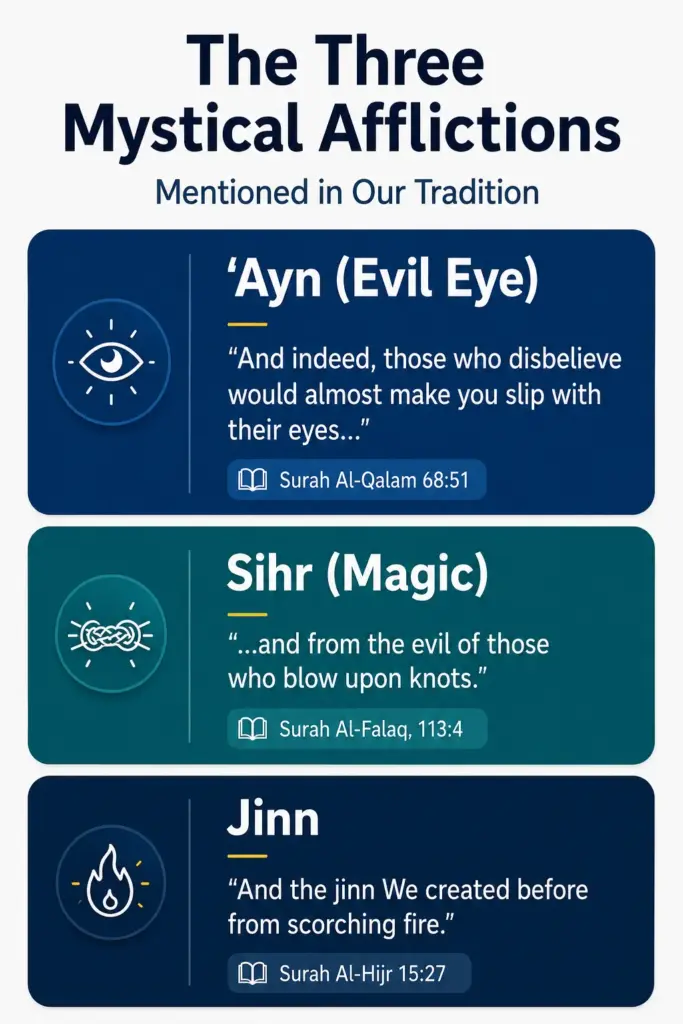
These three doors are distinct, but they often overlap. Sihr almost always involves jinn, because jinn are the ones sent to enforce it. The evil eye can create an opening that jinn later exploit. A person can be dealing with ayn and sihr at the same time. Understanding the categories is not about picking one label and ignoring the rest. It is about recognising patterns clearly enough to respond with the right tools.
How to tell which one you might be dealing with
No article can replace a proper assessment, and self-diagnosis carries its own risks. But there are patterns that point in different directions. These are general markers, not absolute rules. Many real cases involve more than one category at once.
Patterns that point toward ‘ayn (evil eye)
The onset is often sudden and traceable. Something was going well, a blessing was visible, someone commented on it or showed strong admiration, and shortly afterward things shifted. Health dropped, energy drained, a project collapsed, a relationship soured, or a child’s behaviour changed overnight. The timing between exposure and decline is often tight enough that the person can point to it: “It started right after that gathering” or “Everything changed after the wedding.”
Ayn tends to hit what was flourishing. It strikes blessings, not random aspects of life. If your career was thriving and suddenly nothing works, if your child was healthy and vibrant and is now constantly ill, if your marriage was strong and is now suffocating, the pattern may point here.
For a deeper understanding of how the evil eye works, what it can affect, and the Sunnah-based protections against it, read Signs of Evil Eye in Islam: How ‘Ayn and Hasad Actually Work.
Patterns that point toward sihr
Sihr tends to show as a persistent, targeted blockage. It does not scatter across random areas of life. Instead, it hammers one thing relentlessly: marriage is blocked and every prospect falls through. Intimacy between spouses disappears without explanation. A business that should succeed keeps failing in ways that defy logic. Fertility is blocked despite no medical cause.
The hallmarks of sihr are persistence and specificity. The problem does not drift. It stays locked on its target, sometimes for years. You may also notice that things worsen specifically around acts of worship or when you begin treatment. Sihr often has a defensive quality: it pushes back when you try to address it.
Another marker is that sihr was commissioned by someone with intent. In many cases, there is a person in the picture who had a reason: a jealous co-worker, a rejected suitor, a business rival, a hostile acquintance. This does not mean you should start accusing people. But if the pattern of harm aligns with a specific person’s motive and timing, it is worth noting.
For a detailed breakdown of what sihr is, how it works, and the different forms it takes, read Signs of Sihr in Islam: What Black Magic Actually Looks Like.
Patterns that point toward jinn interference
Jinn interference often shows up in the inner world first. Waswas that goes beyond normal doubt: persistent, intrusive, exhausting thoughts that target your faith, your relationships, or your sense of self. Sleep disturbances are common: vivid or recurring nightmares, sleep paralysis, waking at specific times (especially between 1-3am), feeling watched or pressed down at night.
At a deeper level, you may experience mood swings that do not match your circumstances, sudden aversion to Qur’an or salah, feeling physically heavy or agitated in certain places (especially the masjid or your own home), or personality shifts that others notice before you do. In severe cases, there may be episodes of lost awareness, speaking in a voice that is not your own, or physical reactions during Qur’an recitation.
Jinn interference does not always mean possession. The spectrum runs from ordinary waswas (which every person experiences) through increasing levels of influence and disturbance, up to full possession at the extreme end. Most cases fall somewhere in the middle.
For a full explanation of the levels of jinn interference, why jinn target people, and the Islamic response, read Signs of Jinn in Islam: How Jinn Interference Actually Works.
When the picture is mixed
In practice, many cases involve more than one door. Someone may have been struck by the evil eye, and that created a spiritual opening that jinn later exploited. Sihr almost always involves jinn, because jinn are the mechanism through which the magician’s instructions are enforced. A person may have eaten sihr that is causing digestive issues, while separately dealing with ayn that struck their marriage, while the jinn assigned to the sihr are also amplifying waswas.
This is normal. The doors are categories for understanding, not rigid boxes. What matters is not finding a single perfect label. What matters is recognising that something is present, understanding the general shape of it, and beginning treatment in the right way.
If you are unsure where you fall, the diagnostic quiz can help you identify patterns across your symptoms.
The Qur’an and Sunnah confirm these realities
These three categories are not cultural inventions, folk beliefs, or fringe ideas within Islam. They are established directly in revelation.
Allah tells us that sihr can cause separation between husband and wife, but that no harm occurs except by His permission (Surah al-Baqarah, 2:102). He commands us to seek refuge from those who blow on knots (Surah al-Falaq, 113:4) and from the envier when he envies (Surah al-Falaq, 113:5). He reminds us that Shaytan and his tribe see us from where we do not see them (Surah al-A’raf, 7:27).
The Prophet ﷺ confirmed these realities in practice, not just in words. When Sahl ibn Hunayf (R.A) fell suddenly ill after another man admired his appearance, the Prophet ﷺ identified it as the evil eye and prescribed a specific remedy. When a mother brought her son who was repeatedly seized by fits, the Prophet ﷺ commanded the unseen being to leave in Allah’s name, and the boy was cured. When the Prophet ﷺ himself was affected by sihr, the cure came through turning to Allah in du’a until the revelation identified the source.
These narrations confirm three things. These afflictions are real. They can affect anyone, including the most righteous. And the response taught by the Prophet ﷺ is grounded, practical, and free of panic.
Being tested does not mean you are rejected
One of the most important lessons from these texts is that spiritual affliction does not contradict faith. The Prophet ﷺ himself was tested by sihr. He was the most obedient, God-fearing and spiritually pure human being who ever lived, and yet Allah allowed the test to reach him within specific boundaries.
If the best of creation ﷺ could be tested in this way, then an ordinary believer dealing with strange symptoms, persistent blocks, or spiritual heaviness is not cursed or rejected. They are living the same pattern that has always existed: believers are tested in different ways, in the body, in the mind, and through the unseen.
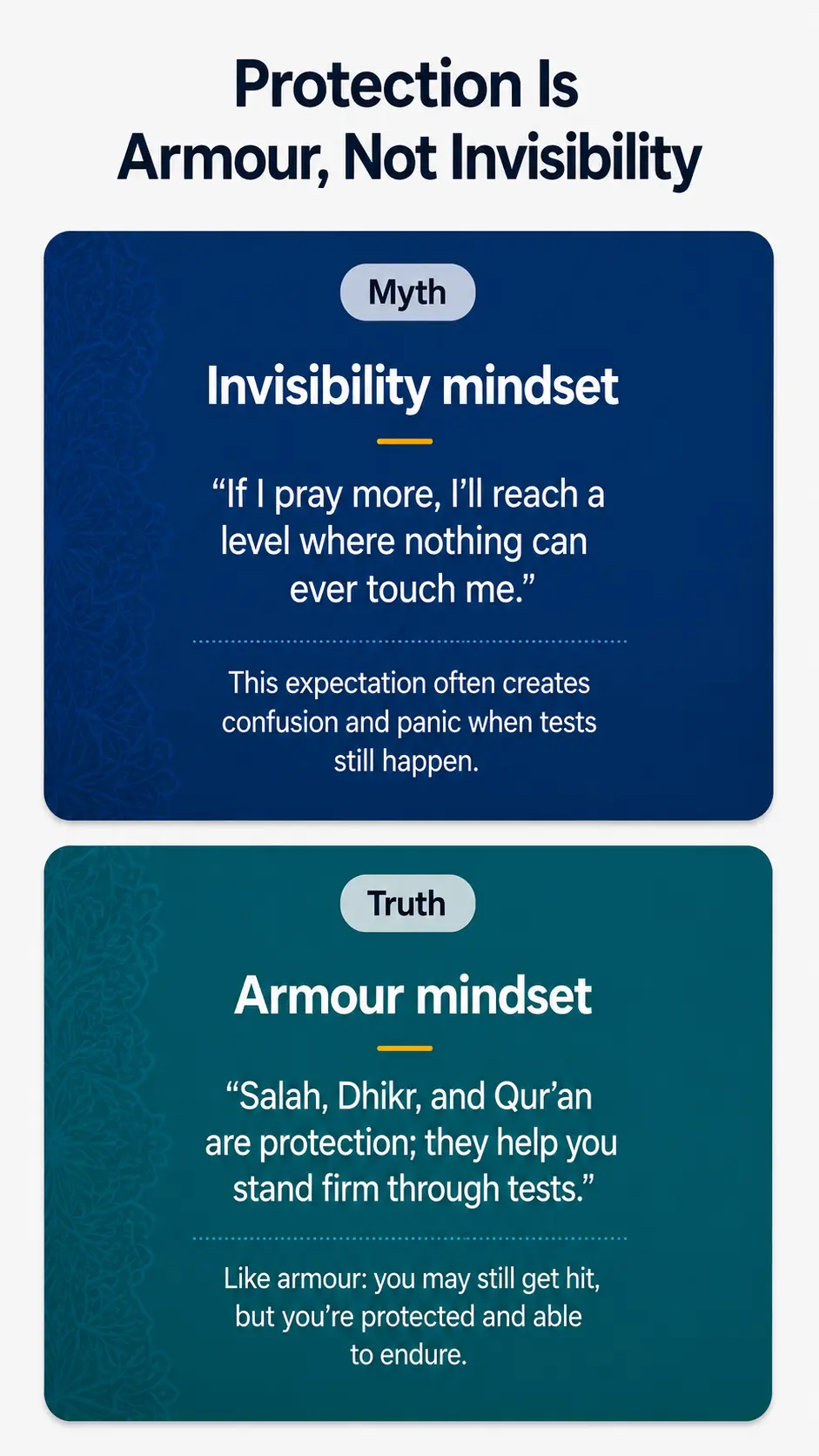
Salah, dhikr, and obedience are powerful shields. They can reduce the likelihood, intensity, and duration of many harms. But they are armour, not invisibility. Armour does not remove you from the battlefield. It allows you to enter it, take hits, and still stand firm.
What distinguishes people in the sight of Allah is not whether they are ever tested, but how they respond when the test comes.
What mystical afflictions are not
It is just as important to say what does not belong in this framework.
A black cat crossing your path does not alter your qadar. Your deceased relatives do not wander as ghosts in your bedroom. Certain numbers, colours, days, and shapes do not possess automatic powers of harm. These ideas might have psychological impact, but they have no recognised mechanism in Qur’an and Sunnah. In fact, placing too much fear and attention on such superstitions can itself become a trap from Shaytan.
At the same time, not every hardship is spiritual. People get physically ill from viruses. People develop depression and anxiety from trauma and life circumstances. Marriages struggle because of communication failures and unmet needs, not only because of sihr. Part of wisdom is learning to discern: treat what you can see, take seriously what you cannot see, and avoid falling into either extreme of blaming everything on the unseen or dismissing it entirely.
What to do next
If you recognise yourself in what you have read, there are clear next steps.
Assess your situation. The diagnostic quiz walks you through a structured self-assessment across six areas of your life. It takes a few minutes and gives you a clear picture of where the patterns are strongest.
Start treatment. The free 14-day self-ruqyah plan gives you a structured, Qur’an-based treatment method you can begin at home today. It is built on symptom-based recitation with specific intentions, not general Qur’an reading. No dependency on a practitioner. No ta’weez. No jinn services.
Go deeper on what you are facing. Each of the three doors has its own detailed guide:
- Signs of Evil Eye in Islam: How ‘Ayn and Hasad Actually Work
- Signs of Sihr in Islam: What Black Magic Actually Looks Like
- Signs of Jinn in Islam: How Jinn Interference Actually Works
Get personalised guidance. If you have been treating for a while and need help identifying what you are dealing with or building a targeted plan, find out how we can help.
Frequently Asked Questions
Can you have sihr and evil eye at the same time? Yes. Many real cases involve more than one type of affliction simultaneously. Someone may have been struck by the evil eye and also be dealing with sihr commissioned by a different person entirely. The evil eye can also create a spiritual opening that jinn later exploit, adding a third layer. Treatment does not require you to identify a single cause before you begin. You treat what is present, and the picture becomes clearer as symptoms respond.
How do I know if my problems are spiritual or medical? You may not need to choose one or the other. A person can have a genuine medical condition and a spiritual affliction at the same time. The mature approach is to pursue medical investigation and treatment for what doctors can see, while also taking seriously any spiritual patterns that do not fit medical explanations: symptoms that resist normal treatment, that behave in patterned or cyclical ways, that worsen around worship, or that appeared suddenly after an identifiable spiritual trigger. Do not abandon medicine for ruqyah, and do not dismiss ruqyah because you have a diagnosis.
Is it possible to be affected without knowing? Yes. Many people live with the effects of spiritual affliction for years without recognising what it is. They may attribute everything to stress, bad luck, personality, or medical conditions. The patterns only become visible when someone learns what to look for. This is one of the reasons structured self-assessment is valuable: it surfaces patterns that you may have been explaining away individually but that form a clear picture when seen together.
Can a practising Muslim be affected by sihr or the evil eye? Absolutely. The Prophet ﷺ himself was affected by sihr, and he was the most righteous human being who ever lived. Practising Islam provides powerful protection and reduces vulnerability, but it does not guarantee immunity. Salah, adhkar, and Qur’an are armour. Armour does not remove you from the battlefield. It equips you to stand firm when the test comes.
The Foundations Series
This is Part 1 of the Foundations Series, covering the Islamic foundations of spiritual affliction and healing.
- Part 1: Sihr, Evil Eye, or Jinn: How to Tell the Difference (you are here)
- Part 2: Signs of Evil Eye in Islam: How ‘Ayn and Hasad Actually Work
- Part 3: Signs of Sihr in Islam: What Black Magic Actually Looks Like
- Part 4: Signs of Jinn in Islam: How Jinn Interference Actually Works
- Part 5: How Sihr, Jinn, and the Evil Eye Create Blockages in Your Life
- Part 6: What Is Ruqyah?
- Part 7: Treatment Tools That Support Ruqyah