
Learn what the evil eye actually is in Islam, how to recognise it in yourself, your children, your home and your marriage, and what the Sunnah teaches about protection and treatment.
You were fine. Then something shifted.
Maybe it was after a family gathering, a wedding, a new job, a pregnancy announcement, or even a moment where things were simply going well. Health dropped. Energy drained. A child who was thriving became constantly ill. A marriage that was strong turned suffocating. A business that was growing suddenly stalled. The timing was too sharp to ignore, but you could not point to a medical cause.
If that pattern sounds familiar, the evil eye may be part of the picture.
The evil eye (‘ayn) is one of the most commonly experienced spiritual afflictions, and it is one of the most misunderstood. Some Muslims dismiss it entirely. Others blame everything on it. Islam teaches a clear middle path: the evil eye is real, it is confirmed in the Qur’an and Sunnah, and there are specific ways to recognise it, protect against it, and treat it.
What ‘ayn and hasad actually are
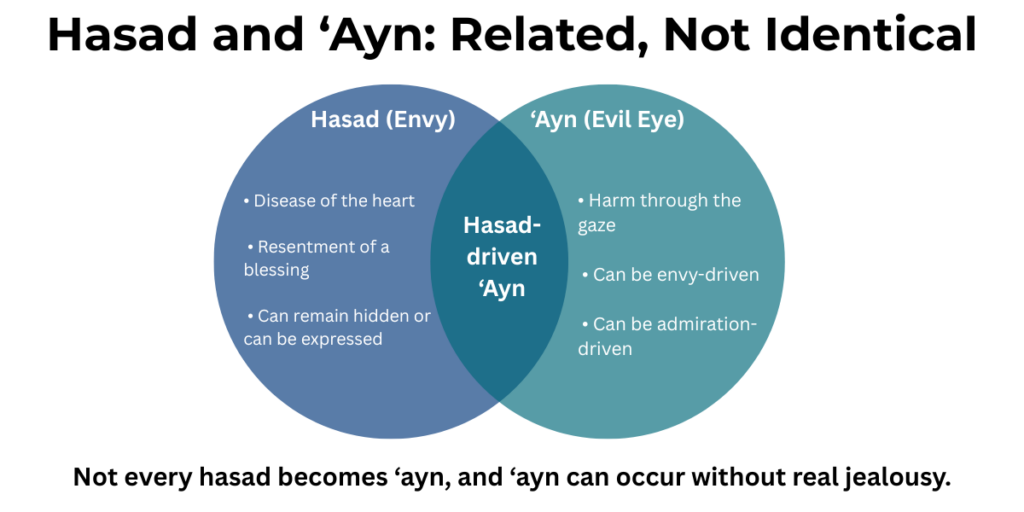
Two terms come up together and people often confuse them.
Hasad is envy in the heart. It is the feeling of resenting someone else’s blessing or wishing it would be taken away. A person can carry hasad without it ever producing a visible effect. It is a spiritual disease of the heart, and it is the one Allah commands us to seek refuge from: “And from the evil of the envier when he envies” (Surah al-Falaq, 113:5).
‘Ayn (the evil eye) is the harmful effect that can travel, by Allah’s permission, from a person’s heart and gaze and strike a blessing in someone else’s life. Scholars explain that every instance of ‘ayn involves some degree of hasad, even if mild or subconscious, but not every hasad produces a strike of ‘ayn.
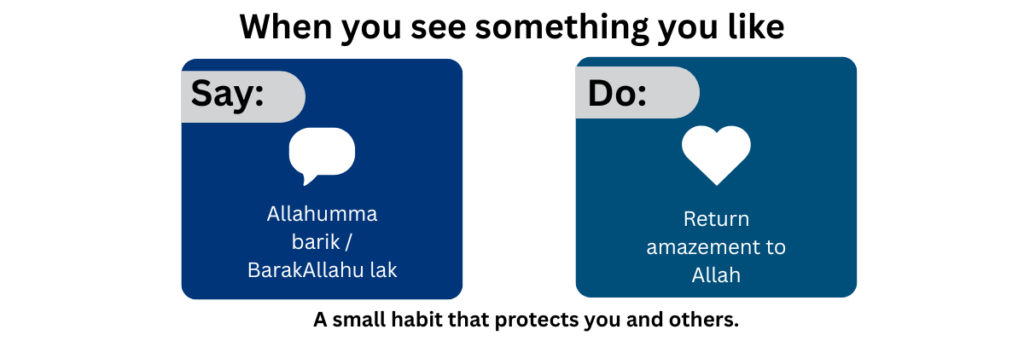
There is a third state that confuses people. A person may be genuinely impressed or amazed by something, whether in their own life or someone else’s, and they forget to remember Allah and ask for blessing. Even without obvious hatred, harm can occur if Allah allows it. This is why the Prophet ﷺ taught us to say “Allahumma barik” or “BarakAllahu lak” when we see something we admire. It is not a cultural formality. It is a spiritual safeguard.
The Prophet ﷺ did not treat the evil eye as a metaphor. He said: “The influence of the evil eye is real. If anything were to precede the Divine Decree, it would be the influence of the evil eye” (Sahih Muslim). It is said that “the evil eye could put a camel in the cooking pot and a man in his grave”.
When Sahl ibn Hunayf (R.A) fell suddenly ill after another companion admired his appearance, the Prophet ﷺ identified it immediately as the evil eye, instructed the one who had caused it to perform a specific washing, and the water was poured over Sahl (R.A). He recovered, and the Prophet ﷺ used the incident to teach the companions not to harm each other through their gaze and to make du’a for blessing when they see something they like.
These are not abstract theological points. They are real incidents with real consequences and real solutions, taught by the Prophet ﷺ himself.
How to recognise the signs of the evil eye
The evil eye can touch almost any blessing in a person’s life. What makes it recognisable is not any single symptom, but the combination of sudden onset, a traceable trigger, and decline in something that was previously flourishing.
In adults
The most common pattern is a sudden, unexplained decline in health, energy, or wellbeing that begins after a moment of exposure or praise. A person who was healthy becomes persistently fatigued. Headaches, nausea, or a general sense of heaviness settle in without a clear medical cause. Mood drops sharply. Motivation and drive disappear. Skin problems or pain may appear seemingly out of nowhere. The person may feel “off” in a way they cannot articulate, as though something has been taken from them.
What distinguishes this from ordinary illness is the timing and the pattern. The decline is sudden rather than gradual. It follows a specific event or period of exposure. It affects what was going well, not random areas of life. And it often resists medical treatment or comes back repeatedly despite treatment.
In children
Children are particularly vulnerable because they are often the centre of attention and admiration. A child who was sleeping well suddenly cannot sleep. A baby who was feeding and growing normally becomes irritable, refuses food, or develops unexplained fevers. A child who was calm and happy becomes clingy, fearful, or prone to tantrums that seem disproportionate.
Parents sometimes notice the shift immediately after a visit from relatives, a public outing, or a social gathering where the child received a lot of attention. The pattern is the same: something was well, admiration or attention occurred, and a noticeable decline followed.
In marriage and relationships
The evil eye can strike a marriage that is visibly happy and stable. Couples who were close begin to feel distant or irritated with each other for no clear reason. Communication breaks down. Warmth disappears. Arguments start over nothing and escalate quickly. One or both spouses may feel an unexplained heaviness or aversion when they are together, even though nothing specific has changed between them.
This is especially common after weddings, public displays of affection or happiness, or when a couple is known in their community for having a strong relationship. The more visible the blessing, the more it attracts attention.
It is important to distinguish this from the effects of sihr, which tends to be more persistent and targeted. Evil eye on a marriage typically causes a general souring or cooling of what was warm, while sihr targeting a marriage often pushes toward active separation, hatred, or specific sexual dysfunction. For more on how sihr affects marriages, read Signs of Sihr in Islam.
In work, business, and wealth
A project that was succeeding suddenly fails. A business that was growing hits a wall. Income dries up without explanation. Opportunities that seemed certain fall through at the last moment. Clients disappear. A person who was productive and sharp becomes unable to concentrate or follow through.
Again, the marker is sudden decline in what was flourishing, often traceable to a moment of visibility or success that attracted attention.
In the home
Sometimes the evil eye does not attach to a single person but to a household. A home that was peaceful becomes tense. Family members argue constantly without clear cause. There is a heaviness in the atmosphere that visitors sometimes comment on. Things break. Sleep is disturbed. People feel drained when they are in the house but better when they leave.
What the evil eye is not
Not every hardship is the evil eye. People get ill from viruses. Businesses fail because of market conditions. Marriages go through difficult phases because of unresolved communication patterns. Children get sick because they are children.
The evil eye becomes a reasonable consideration when the decline is sudden, traceable to a moment of exposure, targets what was flourishing, and does not respond to normal explanations or treatments. If the pattern fits, it is worth taking seriously. If the pattern does not fit, look for other explanations first. Allah gave us both spiritual and practical means of understanding our lives, and wisdom lies in using both.
If you are unsure whether what you are experiencing might be spiritual, the diagnostic quiz can help you assess your situation across multiple areas. For a broader understanding of how the evil eye differs from sihr and jinn interference, read Sihr, Evil Eye, or Jinn: How to Tell the Difference.
Protection from the evil eye: what the Sunnah teaches
Islam does not leave a believer helpless. The Sunnah teaches prevention through consistent daily practice, not through occasional bursts of intensity followed by weeks of neglect. The key is not how hard you go once. It is what you do every day.
Morning and evening adhkar
Make your morning and evening adhkar non-negotiable. This is your daily shield. Seeking refuge in Allah is a direct, revealed response to the reality of the evil eye. When these are consistent, many people notice that disturbances reduce and spiritual pressure lifts. When they are neglected, the openings return.
The Mu’awwidhat
Abu Sa’id al-Khudri reported that the Prophet ﷺ used to seek refuge from the jinn and the evil eye until Surah al-Falaq and Surah an-Nas were revealed, after which he held firmly to them. Recite Surah al-Ikhlas, al-Falaq, and an-Nas regularly within your daily adhkar and before sleep. These three surahs are direct protection from the specific harms described in the Qur’an: sihr, the evil eye, and the whispering of shayatin.
Ruqyah for ‘ayn is Sunnah
‘Aishah narrated that the Prophet ﷺ ordered ruqyah to be performed for protection from the evil eye. This is not an extra, optional practice. It is something the Prophet ﷺ specifically instructed. When you recite over yourself or your family members as protection, you are following a direct command.
Protection for children and loved ones
The Prophet ﷺ used to seek refuge for his grandsons al-Hasan and al-Husayn with the words:
U’īdhukumā bi kalimātillāhi at-tāmmati min kulli shayṭānin wa hāmmatin wa min kulli ‘aynin lāmmah.
“I seek refuge for you both in the perfect words of Allah from every devil and poisonous creature, and from every harmful eye.”
This du’a combines protection from shayatin, harmful creatures, and the evil eye in a single line. Make it part of your routine for your children and for anyone in your care.
Seal admiration with barakah
When you see something you admire in yourself or others, attach it back to Allah. Say “Allahumma barik” or “BarakAllahu lak.” This is not a cultural habit. It is a prophetic instruction that protects blessings, relationships, and hearts. The incident of Sahl ibn Hunayf shows what can happen when admiration is left unguarded. The Prophet ﷺ did not blame the companion who caused the harm through ignorance, but he taught the lesson firmly: guard your gaze with dhikr.
If you suspect you have been affected
If you believe you may have been struck by the evil eye, the response is grounded and practical.
Begin with what the Sunnah already gave. Seek refuge in Allah, increase your recitation of the Mu’awwidhat, and keep your daily adhkar consistent. Do not spiral into suspicion or start accusing people around you. You do not need to identify who caused it in order to treat it.
If you want a structured approach to treatment, the free 14-day self-ruqyah plan gives you a day-by-day method built on symptom-based Qur’anic recitation with specific intentions. It is designed for self-treatment at home, with no dependency on a practitioner.
If your symptoms are persistent, layered, or you are unsure whether you are dealing with ‘ayn alone or something more complex, find out how we can help with a diagnostic assessment or personalised treatment plan.
Frequently Asked Questions
Can someone give you the evil eye without meaning to? Yes. The evil eye does not require malicious intent. A person can cause harm through unguarded admiration or amazement, even toward someone they love, even toward their own child. This is why the Prophet ﷺ taught us to say “Allahumma barik” whenever we see something that impresses us. The safeguard is in the habit of returning admiration to Allah rather than letting it sit as raw fixation.
How is the evil eye different from sihr? The evil eye is typically sudden, unplanned, and strikes what is visibly flourishing. Sihr is deliberate, commissioned, and targeted toward a specific outcome (blocking marriage, causing separation, destroying business). Sihr involves a magician, shirk, and jinn enforcement. The evil eye can come from anyone, including a friend or family member who had no harmful intention at all. For a full comparison, read Sihr, Evil Eye, or Jinn: How to Tell the Difference.
Can the evil eye affect children and babies? Yes, and children are particularly vulnerable because they are often the centre of attention and admiration. The Prophet ﷺ himself used to regularly seek refuge for his grandsons. Parents should make the protective du’a a daily habit, especially after gatherings or when a child has received a lot of attention.
What should I recite to protect myself from the evil eye? The core protections taught in the Sunnah are the morning and evening adhkar, Surah al-Ikhlas, al-Falaq and an-Nas (the Mu’awwidhat), and the du’a of protection for yourself and your family. For children, the du’a the Prophet ﷺ used for al-Hasan and al-Husayn is specifically designed for this purpose. Consistency matters more than length. A short daily practice done every day is more effective than a long session done once and then forgotten.
Is every sudden hardship the evil eye? No. People get ill, businesses face setbacks, and relationships go through difficulty for many reasons that have nothing to do with the unseen. The evil eye becomes a reasonable consideration when the decline is sudden, follows a moment of exposure or praise, targets what was flourishing, and does not respond to normal explanations. If the pattern does not fit, pursue medical, practical, or psychological explanations first.
The Foundations Series
This is Part 2 of the Foundations Series, covering the Islamic foundations of spiritual affliction and healing.
- Part 1: Sihr, Evil Eye, or Jinn: How to Tell the Difference
- Part 2: Signs of Evil Eye in Islam: How ‘Ayn and Hasad Actually Work (you are here)
- Part 3: Signs of Sihr in Islam: What Black Magic Actually Looks Like
- Part 4: Signs of Jinn in Islam: How Jinn Interference Actually Works
- Part 5: How Sihr, the Jinn and Evil Eye Cause Blockages in Your Life
- Part 6: What Is Ruqyah?
- Part 7: Treatment Tools That Support Ruqyah