
Ruqyah is the core of treatment for sihr, jinn, and the evil eye. But there are other halal tools that support it. Learn how Qur’anic water, hijamah, oils, prophetic medicine, and structured thinking strengthen your treatment.
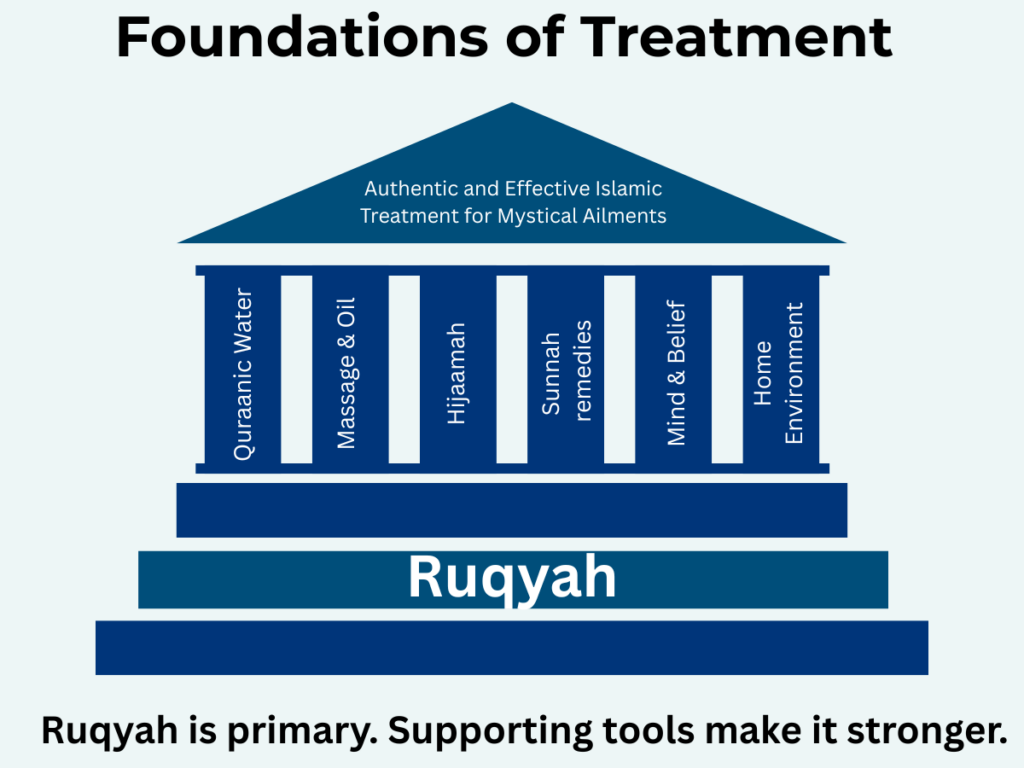
Ruqyah is the heart of treatment. If you have read the previous post in this series, What Is Ruqyah?, you already understand why: it is Qur’an and du’a directed at the affliction within the boundaries of tawheed and the Sunnah. Nothing replaces it. Nothing outranks it.
But ruqyah does not operate in a vacuum. The affliction affects your body, your sleep, your nervous system, your home, your thinking. The recitation targets the spiritual source. The tools in this post target the ways that source expresses in your physical life. They do not replace ruqyah. They support it, and in many cases they make the difference between someone collapsing under the weight of symptoms and someone remaining steady enough to keep treating.
The Prophet ﷺ and the scholars recognised a number of supporting tools that help address how sihr, jinn, and the evil eye interact with the body, emotions, and environment. What follows is an overview of each one: what it does, how it is used, and where it fits in a sound treatment plan.
Qur’anic water
Drinking and washing with water over which Qur’an has been recited is one of the most effective general supports in treatment. Almost every patient can benefit from it, and for certain forms of sihr it can be especially effective by Allah’s permission.
The method sits under a simple principle: Allah can place healing in ordinary means. Water is already a source of purification in Islam, and when it is paired with Qur’anic recitation and correct belief, it becomes a powerful support.
Allah shows us a clear example of healing water in the story of Ayyub (peace be upon him). When he was tested with severe harm, Allah commanded him:
“Strike [the ground] with your foot. This is a spring for washing and drinking.”
(Surah Sad, 38:42)
The Qur’an itself establishes the pattern: Allah may bring cure through water used externally and internally. When Ayyub (A.S) washed and drank from the spring, he was cured from the affliction he was suffering from.
How it is prepared
The primary method is simple: recite Qur’an over clean water with correct belief, then use it. You can recite whatever you are able to recite consistently, but it is beneficial to include al-Fatihah, Ayat al-Kursi, and the Mu’awwidhat (al-Ikhlas, al-Falaq, al-Nas), along with other known ruqyah passages.
Some scholars have also allowed Qur’an to be written in a permissible way and then dissolved into water, particularly when direct recitation is difficult. This should be treated as a support method, not a replacement for recitation, and it must remain free of symbols, unknown writing, or anything suspicious.
Ways it can be used
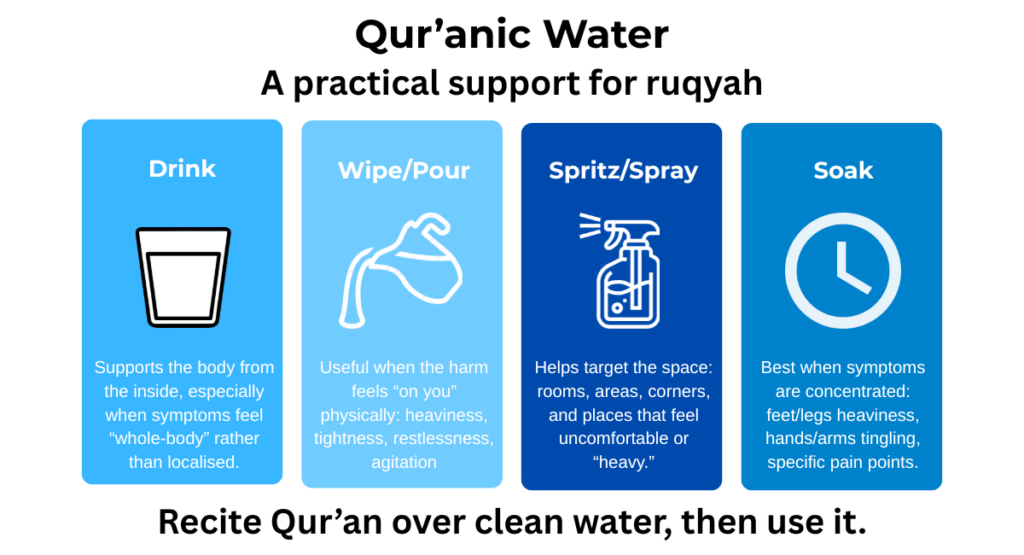
Qur’anic water can be used in several practical ways, depending on symptoms and what a person can manage consistently.
Drink small amounts throughout the day. This is especially useful when symptoms feel general and “whole body”: fatigue, heaviness, anxiety, or persistent internal disturbance.
Wash or bathe by pouring the water over the body in a shower or bath. This is one of the most effective methods when symptoms feel as if they are “on you” physically: heaviness, pressure, agitation, restlessness, or strong reactions after ruqyah.
Wipe over the body with the hands or a clean cloth, especially over areas where pain, heaviness, or tingling is strongest. This is a simple daily method that many people can maintain when bathing is difficult.
Make wudu with it. If a person is experiencing strong spiritual heaviness, unusual agitation, or persistent disturbance, making wudu with Qur’anic water can be a steady way to pair purification with protection.
Soak the hands, feet, or specific affected areas when symptoms are localised or stubborn: heaviness in the legs, pressure in the head, burning sensations, or crawling feelings.
Spritz or spray affected belongings or areas: vehicles, homes, business premises, clothing, gifts, or particular corners of the home that feel “heavy” or where night disturbance concentrates.
Qur’anic water and the evil eye
For the evil eye specifically, the Sunnah links cure to washing. The Prophet ﷺ affirmed that the evil eye is real, and he instructed that when a person is asked to wash as a cure, they should do so properly. Washing and bathing are not merely cultural habits. They sit inside the prophetic toolkit for clearing the effects of ‘ayn.
Keep it grounded
Two reminders keep this method safe and balanced. First, the water has no independent power. It is a means. Cure is from Allah alone. Second, consistency matters more than intensity. A simple routine done steadily often outperforms dramatic bursts followed by collapse.
Cupping (hijamah)
Wet cupping on affected areas is a powerful way of physically drawing out the effects of sihr, jinn, or evil eye from the body. It is particularly suited to cases of stubborn headaches and migraines, chronic back, neck, or limb pain, fertility problems and certain gynaecological issues, and localised heaviness, burning, or pressure. It can also support mental and emotional symptoms; cupping over the head, upper back, or chest has helped many patients with anxiety, low mood, and obsessive thoughts.
The Messenger of Allah ﷺ said: “Indeed the best of remedies you have is cupping.” He also mentioned that on the night of Isra he did not pass any group of angels except that they said: “O Muhammad, order your Ummah with cupping.” In another narration: “Indeed in cupping there is a cure.” Ibn al-Qayyim reports that the Prophet ﷺ was cupped on his head when he was afflicted with magic and that hijamah, when done correctly, is among the best cures for sihr.
For physical effects, cupping is often one of the fastest and easiest tools, especially when combined with ruqyah recitation before the session. It should be done by a trained and trustworthy practitioner, but it deserves a central place in many treatment plans.
Oils and massage
Ruqyah oil and targeted massage provide another way of applying Qur’an to the body, especially where cupping is not possible or not practical on a daily basis.
The method is simple: Qur’an and ruqyah du’as are recited over a suitable oil, such as olive oil or black seed oil. The patient then massages the oil into affected areas while ruqyah is being recited and blown, either by themselves or with help.
Unlike cupping, this can be done daily or even multiple times a day without harming the skin. It is particularly helpful for localised pain and heaviness, muscle tension linked to jinn presence, and anxiety and low mood when massaged into the chest, shoulders, and head. It is also a practical home tool between more intensive sessions.
Prophetic medicine and diet
Alongside Qur’anic recitation and supplications, the Prophet ﷺ guided us to remedies from the natural world that carry both physical and spiritual benefit. These are not merely “alternative medicine.” They are part of a divinely inspired system of healing that nourishes body and soul.
Senna is often used when sihr was ingested, to cleanse the intestines and help expel harmful material.
Honey is described in the Qur’an as healing for mankind. It strengthens the immune system and soothes the gut lining.
Black seed is the remedy about which the Prophet ﷺ said it is a cure for every disease except death. It reduces inflammation and supports resilience.
Olive oil, taken or applied, is a food of barakah and an oil mentioned in the Qur’an as luminous and blessed.
Dietary changes sit alongside these remedies. When a person reduces excessive sugar, heavily processed food, and constant fried meals, and instead nourishes themselves with wholesome, halal, minimally processed, and anti-inflammatory foods, the body becomes less of a comfortable host for affliction. A cleaner diet can reduce bloating and digestive irritation, skin flares, fatigue, and mood swings, all of which often accompany sihr-related illness.
From a modern perspective, many of these remedies work by calming inflammation, balancing the gut, and supporting the nervous system. This explains why they may relieve not only physical symptoms, but also anxiety, low mood, and brain fog that accompany mystical afflictions. When combined with ruqyah, prophetic medicine lightens the body’s burden and strengthens its defences, making it easier to stand in worship and continue treatment.
Smoke and fragrance
Pleasant smoke and fragrance can also play a role, especially in cases with strong jinn presence. Substances like frankincense or suitable types of bukhoor can be recited over and then used to smoke the body, clothing, and rooms. This can be particularly useful in cases of lustful jinn or homes that feel spiritually heavy.
The idea is not that the smoke itself has magical power, but that it is a medium jinn often dislike, combined with Allah’s words through ruqyah. The same conditions of tawheed apply: no calling on anyone other than Allah, no strange formulas, and no belief in independent power.
Structured thinking
One of the most underestimated ways sihr, ‘ayn, and jinn interference affect a person is through the inner world. Not just feelings, but the sentences running in the mind all day. Afflictions do not only block your life from the outside. They get into your thinking. They install patterns of hopelessness, avoidance, and fear that start reinforcing the blockage from the inside. Over time, the person’s own nervous system and beliefs begin doing the affliction’s work for it.
This is why some people remain stuck even after ruqyah begins to weaken the spiritual source. The mental patterns keep running out of habit. The thought “nothing will ever change” was planted by the affliction, but it became the person’s own voice. The avoidance was triggered by jinn or sihr, but it became a daily routine. Without addressing these patterns directly, the blockage retains its internal grip even as its spiritual power fades.
Structured thinking tools drawn from Cognitive Behavioural Therapy (CBT), grounded in an Islamic framework, help you identify and interrupt those patterns. The core method is straightforward: catch the specific thought that is keeping you stuck, test whether it is actually true, replace it with something balanced and truthful, and take one small action anyway. The goal is not to “think positive.” The goal is to think truthfully, and then act, so that the blockage loses its grip on your behaviour as well as your beliefs.
This is not an alternative to ruqyah. It is a way of refusing to let waswas, despair, and distorted thinking become another chain around you. Ruqyah breaks the spiritual grip by Allah’s permission. Structured thinking breaks the inner grip. When both are addressed together, healing becomes faster, steadier, and more complete.
The CBT and Islamic Healing series covers this in full across four posts: how spiritual affliction gets into your thinking, the specific thought patterns that keep people paralysed, the deeper core beliefs underneath them, and the practical tools to challenge and replace them. If you find that your ruqyah is progressing but your mind still speaks the language of defeat, that series is where to go next.
These tools support ruqyah. They do not replace it.
You now have a map of the main halal tools that sit around the core of treatment. Qur’anic water, hijamah, oils, prophetic medicine, dietary change, smoke and fragrance, structured thinking. Each one addresses the way affliction interacts with the body, the nervous system, the emotions, or the environment. In many cases, they make the difference between someone collapsing and someone remaining steady enough to continue.
But none of them can take the central place that belongs to Qur’an and du’a. A person could have the best therapist, the most skilled hijamah practitioner, perfect supplements and diet, yet if they bypass ruqyah and hang their hopes on human beings, they will always feel that something is missing. The root of the problem is in the unseen. The root of the answer has to come from the Lord of the unseen.
The opposite is also true. A person may have limited resources, weak recitation, and a heavy past. They may have no access to specialists at all. But if they cling to ruqyah with sincerity, clean their life of haram step by step, persevere through setbacks, and keep returning to Allah with His words and His Messenger’s words, help will come in ways no magician or “healer” could ever manufacture.
The path is clear: stand in front of Allah as a needy servant, recite His Book, use the du’as He taught, purify your income and habits, use the lawful tools He has made available to you, and attack the affliction from every angle you have been given. That path may take time. It may require patience. But every step on it is rewarded, even before full cure comes.
If you are ready to put all of this into practice, the How to Unblock Your Life with Quran series takes you through the full self-treatment method step by step: how to build your symptom list, how to run a session, how to use the water and oil, how to build practical effort alongside your recitation, and how to keep going when the affliction fights back.
What to do next
Assess your situation. The diagnostic quiz walks you through a structured self-assessment across six areas of your life. It takes a few minutes and gives you a clear picture of where the patterns are strongest.
Start treatment. The free 14-day self-ruqyah plan gives you a structured, Qur’an-based treatment method you can begin at home today. It is built on symptom-based recitation with specific intentions, not general Qur’an reading. No dependency on a practitioner. No ta’weez. No jinn services.
Learn the full method. The How to Unblock Your Life with Quran series walks you through every stage of treatment, from diagnosis through to adjustment and resolution.
Work on the mental patterns. If you find that your thinking is keeping you stuck even as treatment progresses, the CBT and Islamic Healing series gives you practical tools to break the inner grip.
Get personalised guidance. If you have been struggling for a while and need clarity on what you are dealing with or a targeted plan, find out how we can help.
Frequently Asked Questions
Can I use these tools without doing ruqyah? You can, and some of them (hijamah, diet, structured thinking) have standalone benefits for your health. But for spiritual afflictions specifically, these tools are supports around ruqyah, not replacements for it. Ruqyah is the core of treatment because it addresses the spiritual source directly. Using only the supporting tools without recitation is like treating the symptoms while leaving the cause untouched.
How do I make ruqyah water? Recite Qur’an over clean water with correct belief and intention. Al-Fatihah, Ayat al-Kursi, and the Mu’awwidhat (al-Ikhlas, al-Falaq, al-Nas) are the most commonly used passages. You can recite directly over the water and blow into it. Use it by drinking, washing, wiping over the body, or spraying in affected areas. Consistency matters more than quantity.
Is hijamah necessary for treatment? It is not obligatory, but it is one of the fastest tools for physical symptoms, especially stubborn pain, headaches, and heaviness. The Prophet ﷺ described cupping as one of the best remedies, and Ibn al-Qayyim reports that Nabi ﷺ was cupped on his head when afflicted with sihr. If you have access to a trained, trustworthy practitioner, hijamah is well worth including in your treatment.
What if I cannot access a cupping practitioner or afford these tools? The beauty of this system is that its most powerful elements cost nothing. Ruqyah requires only your voice, your intention, and the Qur’an. Water is available to everyone. Cheaper olive oil is affordable. The structured thinking tools require only a pen, paper, and willingness to be honest with yourself. Do not let the absence of specialist access stop you from treating. Work with what you have and trust that Allah does not burden a soul beyond what it can bear.
Can I use essential oils or other modern products? Olive oil and black seed oil are established in the Sunnah and are the primary recommendation. If you use other oils, keep the principle clear: the power is in the Qur’an recited over them and in Allah’s permission, not in the substance itself. Avoid products marketed with exaggerated spiritual claims, strange ingredients, or anything that sits outside clear halal boundaries.
The Foundations Series
This post is Part 7 of the Foundations Series.
- Part 1: Sihr, Evil Eye, or Jinn: How to Tell the Difference
- Part 2: Signs of Evil Eye in Islam: How ‘Ayn and Hasad Actually Work
- Part 3: Signs of Sihr in Islam: What Black Magic Actually Looks Like
- Part 4: Signs of Jinn in Islam: How Jinn Interference Actually Works
- Part 5: How Sihr, Jinn, and the Evil Eye Create Blockages in Your Life
- Part 6: What Is Ruqyah?
- Part 7: Treatment Tools That Support Ruqyah (you are here)