A Quick Recap and Where We’re Headed
This post is part of a series on mystical afflictions in Islam, approached within a Qur’an and Sunnah framework. In Part 1, we established that the unseen is real, that harm only occurs by Allah’s permission, and that we must avoid two extremes, denial and obsession.
We also introduced a simple map: the three main channels through which unseen harm can occur. These are ‘ayn (the evil eye), sihr (magic), and jinn interference. If you have not read Part 1 yet, start here: [link to Part 1].
In the previous posts, we covered the first two channels: ‘ayn (the evil eye) and sihr (magic), and clarified how they work, why they are real, and how a believer responds without falling into extremes. You can read them here: [link to ‘Ayn post] and [link to Sihr post].
Now we move to the third channel: harm through the actions and presence of jinn.
Pathway 3: Harm through the actions and presence of jinn
Jinn are a real, invisible creation of Allah, made from smokeless fire. They live, marry, have offspring and die. They eat and drink. They are obligated to worship Allah and will be judged on the Day of Resurrection. Among them are believers and righteous individuals; disbelievers, hypocrites and rebels; and devils (shayatin) who specialise in misguiding and harming.
Allah says:
“And the jinn We Created before from scorching fire.”
(Surah Al-Hijr, 15:27)
And He says:
“Indeed, he [Shaytan] sees you, he and his tribe, from where you do not see them.”
(Surah Al-A‘raf, 7:27)
Three levels of jinn interference
Classical scholars of Ahl al-Sunnah affirm that jinn can possess humans, influence them and speak through them. This is not a fringe belief, but something established by both experience and authentic texts.
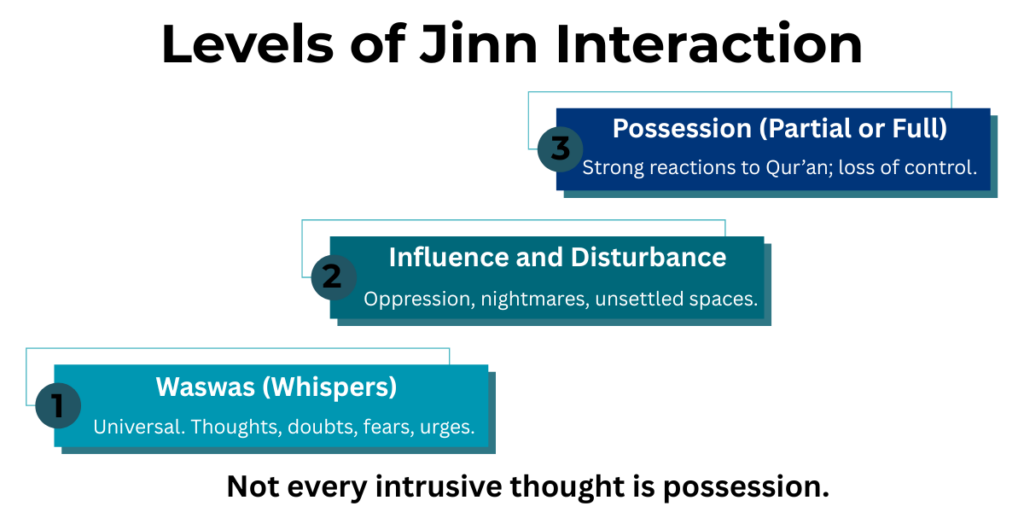
We can think of jinn interaction with humans on different levels. At the most basic level, there are whispers (waswas), which are universal. Every human experiences them. Shaytan suggests thoughts, doubts, fears and desires. He tries to colour how you interpret events and how you think about Allah, yourself and others. Not every intrusive thought is a sign of possession. Often it is “basic” waswas that needs spiritual and psychological tools, which we will discuss later.
A deeper level involves influence and disturbance without full possession. A person may sense a presence in the home: noises, movements, shadows, a feeling of being watched. They may suffer recurring nightmares, sleep paralysis or a sense of oppression at night. They may experience heavy mood swings or agitation in particular places or at particular times, especially around acts of worship. They may feel driven towards certain sins or forms of self-destructiveness that seem disproportionate to their usual character.
The deepest level is partial or full possession. In such cases, there may be strong physical reactions during Qur’an recitation: shaking, screaming, collapsing, changes in voice or facial expression. A person may enter states in which they later have no memory of what they said or did. A jinn may speak through them when confronted, sometimes revealing how and why it came, or threatening further harm. We see hints of these realities in authentic narrations: the boy who suffered repeated fits and was cured when the Prophet ﷺ commanded the jinn to leave by Allah’s name; the ifrit who tried to attack the Prophet ﷺ in salah and was overpowered; and the report that Iblees sends out detachments and praises most the one who causes separation between husband and wife.
Why do jinn attack humans?
From experience and texts, several common reasons emerge as to why jinn attach themselves to people.
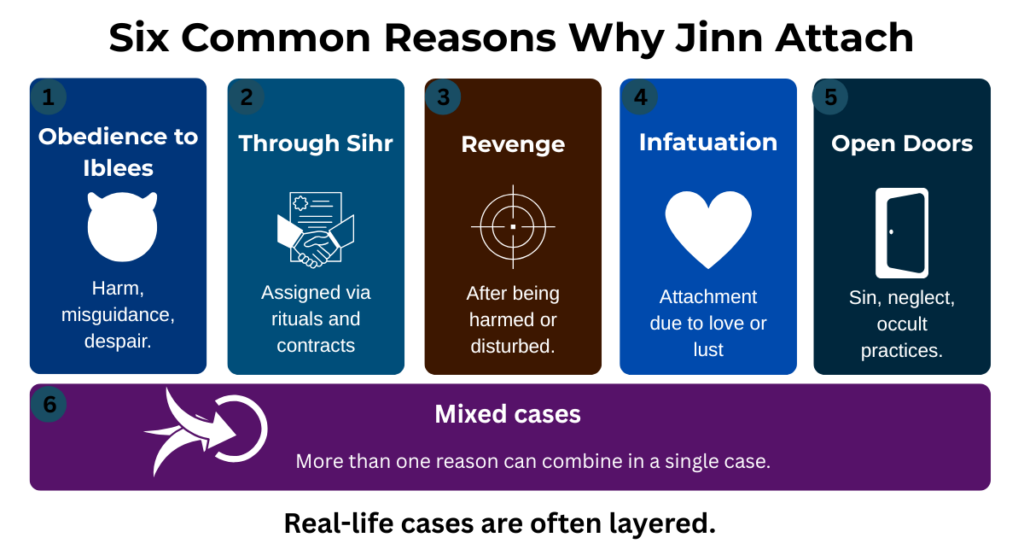
Some do so out of obedience to Iblees and hatred of humans, simply following orders and enjoying causing harm, misguidance and despair.
Others are hired through sihr, paid through sacrifices and acts of shirk to enforce the instructions of the magic.
Some attach themselves out of revenge after being harmed, whether deliberately or accidentally, in places they inhabit.
Others become infatuated – this is the case of jinn ‘ashiq, where a jinn is attached to a person’s beauty, voice, character or sins and “claims” them, interfering with marriage and relationships.
Finally, some jinn are drawn in through openings created by sin and neglect; certain environments and lifestyles signal “you are welcome here” to shayatin – persistent major sins, occult games, séances, fortune-telling, and complete neglect of salah and adhkar.
In reality, cases are often mixed. A jinn may originally come through sihr and later develop its own attachment or hatred over time. Or it may come for revenge and then be recruited into magic.
Conclusion
Jinn are real, and the Qur’an and Sunnah speak about them clearly. They can interact with human beings in different ways, from ordinary waswas that every person faces, to heavier disturbance, and in some cases partial or full possession. But these realities should not push a believer into fear, superstition, or an obsession with the unseen. Allah is in complete control. No jinn can harm, attach, or remain except by His permission, and no case is beyond His protection and cure.
A balanced Muslim approach is to recognise the levels properly, respond with the Sunnah consistently, and avoid careless labels. Not every intrusive thought is possession, and not every hardship is jinn. At the same time, we do not dismiss clear spiritual patterns when they exist. We take the means Allah gave us: regular salah, morning and evening adhkar, Qur’an in the home, ruqyah when needed, tawbah, and removing openings created by sin and neglect. Alongside this, we use practical wisdom: improving routines, addressing mental and physical health, and taking responsibility for what we can change.
When you hold this framework, you gain something most people lack: calm clarity. You stop guessing, you stop panicking, and you start responding with principle and consistency.
How these three pathways overlap
We have in this series so far looked at the evil eye, magic and now jinn.
Real-life cases are rarely neat and isolated. These three pathways often overlap and feed into one another.
A person might be praised excessively for their beauty or success and then struck with the evil eye. They become weak, anxious, and withdrawn. Shayatin then exploit that weakness with further waswas and sinful temptations. In another case, a marriage may be targeted with sihr. Jinn are assigned to create disgust and conflict between the spouses. Over time, those same jinn begin whispering to each spouse outside the marriage as well, fuelling sins, paranoia, and isolation. In yet another scenario, a home is filled with sin, shouting, neglect of salah, and immodest media. Shayatin find it a comfortable base. Someone in that environment then becomes a target of hasad from outside, which amplifies instability that was already present.
Understanding how these pathways overlap helps you avoid both paranoia and denial. On one side, it keeps you from blaming “jinn” for everything. On the other, it prevents you from dismissing every spiritual pattern as “just stress” or “only mental health.” It allows you to approach each case with a structured, principled mindset.
Summary of the three pathways
Islam rejects random superstitions, but it affirms real unseen harms. The main pathways of mystical affliction are: harm rooted in envy and the gaze (‘ayn / hasad), harm rooted in ritual contracts with shayatin (sihr), and harm rooted in the presence and actions of jinn (waswas, disturbance, possession). These pathways are morally charged, structured, and always under Allah’s permission.
In real life, they often overlap. Jinn can be the “operators” behind both sihr and envy-driven harm, and they may exploit weaknesses created by fear, sin, neglect, or instability in a person’s life and environment.
As always, if you want to take action now, jump ahead to Treatment Tools, which explains the accepted and effective means of treatment. If you want to continue the series in order, go forward to Pathway 2: Sihr. If you want a simple structure to begin immediately, download the 7-Day Treatment Plan. And if you want guided support and a personalised plan, you can work with me.
What comes next
In the next section, we will move from causes to effects: what these afflictions can do in a person’s life, body, emotions, relationships, and dreams, and how to recognise patterns without falling into either paranoia or naïve dismissal.