A Quick Orientation and Where We’re Headed
This is Part 1 of a blog series on mystical afflictions in Islam, strictly within the boundaries of the Qur’an and Sunnah.
In this first post, we lay the foundation: what we mean by “mystical afflictions,” and the three main pathways of harm: ‘ayn, sihr, and jinn interference, with clear evidence from revelation.
In the next posts, we will go deeper into each pathway, then look at real-life patterns, how to read them without obsession, and the practical steps of protection and treatment.
Introduction: The Reality of Mystical Afflictions
Across cultures and generations, people have described strange experiences that do not fit neatly into medical tests or everyday explanations: sudden blockages in life, marriages that collapse without an obvious cause, constant arguments, unexplained illnesses, terrifying dreams, or a heavy darkness that settles over a person or a home.
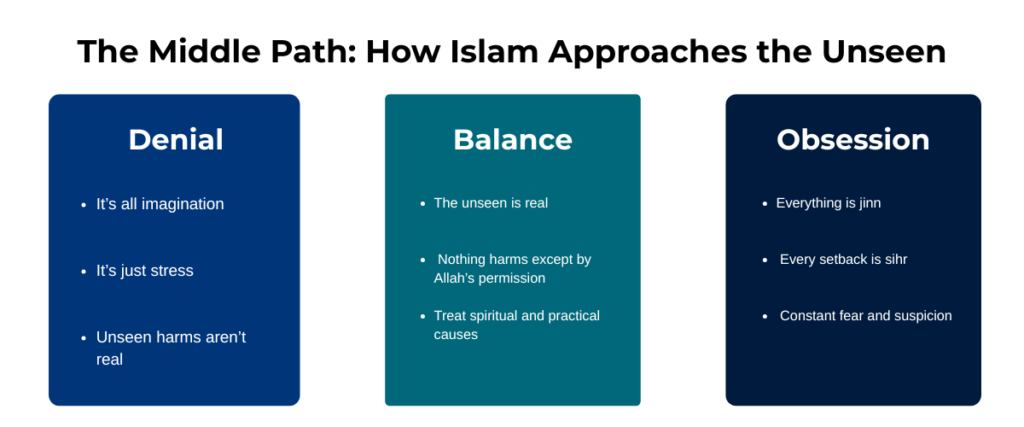
Some dismiss these things as imagination, coincidence or “just stress.” Others rush to the opposite extreme and blame everything on jinn or magic. Islam gives us a balanced, grounded middle path. Our deen teaches us that there is an unseen world, that unseen harms are real, and that they can interact with our lives in very concrete ways – but always within the power and permission of Allah.
This blog starts by establishing that reality.
The unseen world is part of faith
Belief in the unseen (al-ghayb) is one of the first qualities Allah mentions about the people of taqwa in Surah Al-Baqarah. Among the unseen matters that Islam affirms are the existence of the jinn, the reality of shayatin, the presence of envy and the evil eye, and the existence of magic (sihr). These are not folklore or cultural add-ons; they are part of what has been revealed.
Allah tells us that the devils teach people magic and that some people learn it, even if it destroys their Hereafter:
“They followed what the devils recited during the reign of Sulayman. Sulayman did not disbelieve, but the devils disbelieved, teaching people magic… and they learn from them that by which they cause separation between a man and his wife. But they do not harm anyone through it except by permission of Allah…”
(Surah Al-Baqarah, 2:102)
He teaches us that some people actively practice evil, such as blowing on knots as part of their dark rituals:
“…and from the evil of those who blow upon knots.”
(Surah Al-Falaq, 113:4)
He warns us about envy and the harm that can come through a person’s gaze and heart:
“And from the evil of the envier when he envies.”
(Surah Al-Falaq, 113:5)
And He reminds us that the jinn and shayatin are a real creation, with a perspective we do not have:
“Indeed, he [Shaytan] sees you, he and his tribe, from where you do not see them…”
(Surah Al-A‘raf, 7:27)
Taken together, these ayat form a clear picture: there are real unseen forces that can be a source of harm, and a believer is meant to be aware of them.
What Are Mystical Afflictions?
Before we talk about symptoms and treatment, we need a precise map of what we are actually dealing with.
Many Muslims live in a fog of mixed beliefs. They may have heard of the evil eye, jinn and sihr from khutbahs or family stories. They may have grown up with cultural ideas about “bad luck,” haunted houses and curses. At the same time, they may have been told, “Do not believe in any of that, it is all in your head.”
The Qur’an and Sunnah give us something much clearer than either culture or complete denial. Revelation confirms that real unseen harms exist, but they are not random. They follow specific patterns and categories. At the same time, much of what people casually blame on “jinn” or “bad luck” has no basis in the Shari‘ah.
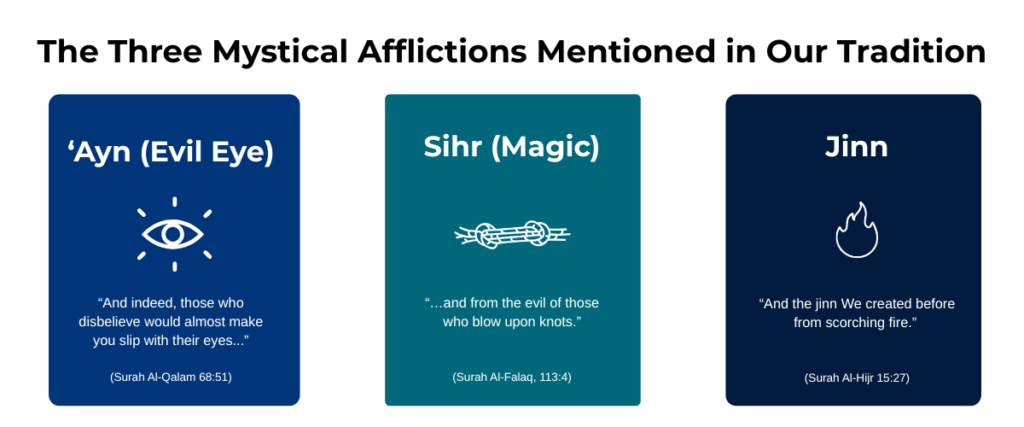
In this book, when we speak about mystical afflictions, we are mainly talking about three doors:
harm that comes through envy and the gaze (evil eye / hasad / ‘ayn)
harm that comes through ritual contracts with shayatin (sihr / magic / witchcraft)
harm that comes through the actions and presence of jinn (whispers, touch, disturbance, possession).
Almost every genuine case will be connected to one or more of these doors. Everything else needs to be filtered carefully through this framework.
Before we deepen each door, it is just as important to say what mystical afflictions are not.
What mystical afflictions are not
From an Islamic point of view, a black cat crossing your path does not alter your qadar. Your deceased relatives do not wander as “ghosts” in your bedroom. Certain numbers, colours, days and shapes do not possess automatic powers of harm. These ideas might have psychological impact on a person, but they have no recognised mechanism in Qur’an and Sunnah. In fact, placing too much fear and attention on such superstitions can itself become a trap from Shaytan.
By contrast, the three doors described in this section do have mechanisms, descriptions and examples in revelation. They are not folklore. They are part of what Allah has told us about the unseen.
The Prophet ﷺ affirmed these harms as real
In the Sunnah, the Messenger of Allah ﷺ does not treat these issues as superstition. He verbally confirms them, explains their seriousness, and at times directly confronts them.
He ﷺ said about the evil eye:
“The influence of the evil eye is real. If anything were to precede the Divine Decree, it would be the influence of the evil eye.”
(Sahih Muslim)
In another narration, he explained its power in vivid terms, saying that the evil eye could cause a camel to end up in the cooking pot and a man in his grave. This is a strong warning that the spiritual and emotional states of others – their envy, jealousy, or even uncontrolled amazement – can, by Allah’s permission, have real-world consequences on our health, our wealth, and our lives.
The Prophet ﷺ also taught his companions practical responses to these realities. When Sahl ibn Hunayf (RA) fell ill after another man commented on his appearance, the Prophet ﷺ identified it as the effect of the evil eye and instructed that the envier perform a specific washing, which was then poured over Sahl. He recovered by Allah’s mercy, and the Prophet ﷺ used this moment to teach the companions not to harm each other by their gaze and to make du‘a for blessing when they see something they like.
We also find clear evidence of jinn interference. In one authentic narration, a boy was repeatedly seized by fits. His mother brought him to the Prophet ﷺ, who placed the child before him, opened his mouth and commanded the unseen being:
“In the Name of Allah, I am the slave of Allah, so leave, O enemy of Allah!”
The boy was cured, and the mother later reported that the problem did not return.
These narrations all point to the same conclusion: the Messenger of Allah ﷺ treated these afflictions as real, dealt with them directly, and taught the Ummah how to recognise and respond to them.
Even the best of creation was tested
One of the most important proofs that mystical afflictions are real – and that they do not contradict a person’s piety – is the incident in which the Prophet ﷺ himself was affected by magic.
‘Aishah (RA) narrates that magic was worked on the Prophet ﷺ until he would imagine that he had done something when he had not done it. This continued until he made du‘a to Allah for a long period. Then he said that Allah had informed him of the cure. In a dream, two angels spoke about his situation, identifying the person who had performed the magic, the materials used, and where they had been placed. The Prophet ﷺ went to the well that was mentioned and described how its surroundings appeared strange and unsettling, but he did not remove the objects. He said that Allah had already cured him and that he feared spreading further harm or panic among the people if he exposed the details.
There are several key lessons in this one incident:
The affliction did not occur because the Prophet ﷺ was negligent in worship. He was the most obedient, God-fearing and spiritually pure human being.
The magic affected him in a specific way, within boundaries set by Allah. It did not cancel his prophethood, his truthfulness or the message he conveyed.
The resolution came through turning to Allah, not through abandoning tawakkul or becoming suspicious of everyone around him.
If the best of creation ﷺ could be tested in this way, then an ordinary believer being tested by strange symptoms, persistent blocks or spiritual heaviness is not a sign that they are cursed, or rejected. It is a sign that they are living the same pattern that has always existed: believers are tested in different ways, in the body, in the mind and through the unseen.
The ifrit in the masjid: even worshippers are targeted
Another narration describes an ‘ifrit from the jinn attempting to disturb the Prophet ﷺ during salah. The Prophet ﷺ said that an ‘ifrit came with a flame of fire to throw in his face while he was praying. Allah gave him the strength to overpower that being, and he even considered tying it to a pillar of the masjid so that people could see it in the morning, but then he remembered the special kingdom granted to Sulayman (peace be upon him) and let it go, humiliated.
There is a subtle but important point here:
The attack happened in the masjid, during salah, to the Messenger of Allah ﷺ.
Being in a sacred place and in a state of worship did not prevent the attempt from occurring, but Allah’s protection prevented it from succeeding.
The Prophet ﷺ did not treat the attempt as impossible simply because of where he was or who he was. He recognised the reality and dealt with it calmly, without panic or obsession.
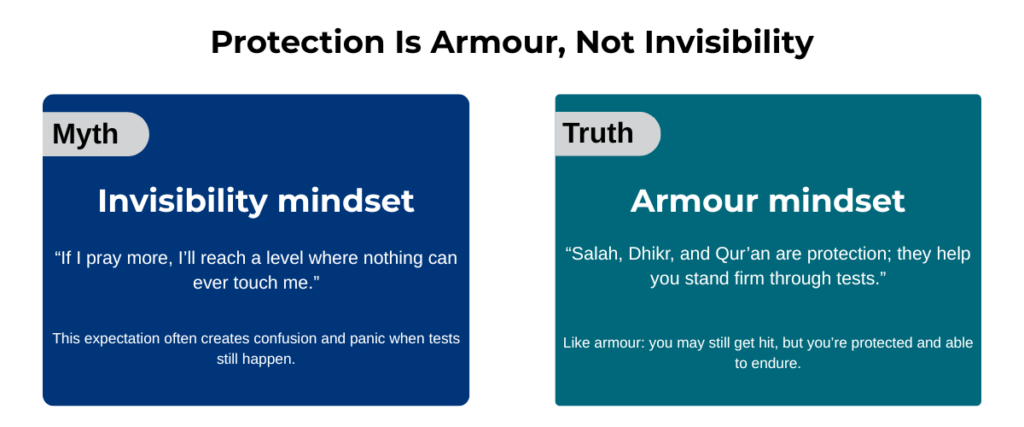
This is a powerful correction to the idea that “if I just pray more, I can reach a level where nothing can ever touch me.” Yes, salah, dhikr and obedience are among the strongest forms of protection, but they do not remove you from the human condition of being tested. They equip you to face those tests.
Being religious does not mean you are untouchable
From these and other narrations, several principles become clear:
Tests are part of iman, not the opposite of it. Prophets, companions and righteous people faced severe trials, both in the seen and unseen. Being tested is not a sign that Allah hates you; often it is a sign that He is purifying, elevating or redirecting you.
Mystical afflictions do not only target “weak” Muslims. In reality, Shaytan is more interested in disturbing those who are trying to obey Allah, damaging their worship, breaking their families, and pushing them into despair or extremism.
Symptoms do not define your rank with Allah. Strange dreams, sudden blocks, or persistent heaviness do not automatically mean you are distant from Allah. What matters is how you respond: with tawbah, patience, dua and seeking knowledge, or with anger, accusation and disobedience.
Daily adhkar, Qur’an, salah, charity, good character, and avoiding sin – all of these are powerful shields. They can reduce the likelihood, intensity and duration of many harms, including mystical ones.
However, they are not a promise that you will never be touched by harm at all. Even with a strong immune system, a person can still catch an illness. Even with a solid spiritual routine, a person can still be struck by envy, targeted by sihr, or bothered by the jinn.
Think of protection as armour, not as invisibility. Armour does not remove you from the battlefield; it allows you to enter it, take hits, and still stand firm.
In summary, mystical afflictions can reach anyone: the new Muslim, the lifelong practicing Muslim, the scholar, the student, the parent, the child. What distinguishes people in the sight of Allah is not whether they are ever tested by such things, but how they respond when the test comes.
A world where the seen and unseen intersect
When we put these texts together, a picture emerges of how a Muslim should understand mystical afflictions:
There is an unseen world that we cannot view directly, but whose effects sometimes show up in our bodies, minds, relationships and circumstances.
There are real harms that may come through envy, magic, and jinn interference, by Allah’s permission.
These harms can affect anyone: children and adults, practicing Muslims and those far from the deen, men and women, the apparently “strong” and the visibly “weak.”
Our tradition speaks about these matters openly and repeatedly; they are not fringe topics but part of the revealed guidance.
At the same time, our belief in these afflictions does not cancel our belief in medical causes, psychological patterns, or personal responsibility. A person can be physically ill due to a virus and also spiritually vulnerable. Someone can be struggling with trauma, cognitive distortions and negative thinking – and also under the influence of envy or sihr. Part of wisdom is learning to discern, to treat what we can see, and to take seriously what we cannot see, without falling into extremes.
In this blog, we will not rush to label every hardship as “magic” or every anxiety as “jinn.” Instead, we will start from this firm foundation: mystical afflictions are real, they are part of the unseen that Allah and His Messenger ﷺ told us about, and they can touch the lives of ordinary believers.
From this foundation, the next posts will:
Describe these afflictions in more detail,
Explore the types of problems they can cause in a person’s life, and
Then walk through structured, practical steps for seeking healing and protection.
We begin with ‘Ayn (the evil eye), followed by sihr and then jinn interference.
In the next post you’ll learn:
What ‘Ayn is (and what it is not)
How it differs from superstition and fear-based thinking
The Sunnah-based response that keeps you grounded and protected
.