A Quick Recap and Where We’re Headed
This is Part 2 of a blog series on mystical afflictions in Islam, strictly within the boundaries of the Qur’an and Sunnah.
In Part 1, we established that the unseen is real, that harm only occurs by Allah’s permission, and that we must avoid two extremes, denial and obsession.
We also introduced a simple map: the three main channels through which unseen harm can occur. These are ‘ayn (the evil eye), sihr (magic), and jinn interference. If you have not read Part 1 yet, start here: [link to Part 1].
Now we move from foundations to details. We begin with the first channel: harm through envy and the gaze.
Pathway 1: Harm through envy and the gaze (evil eye / hasad / ‘ayn)
Definition: Hasad and ‘Ayn
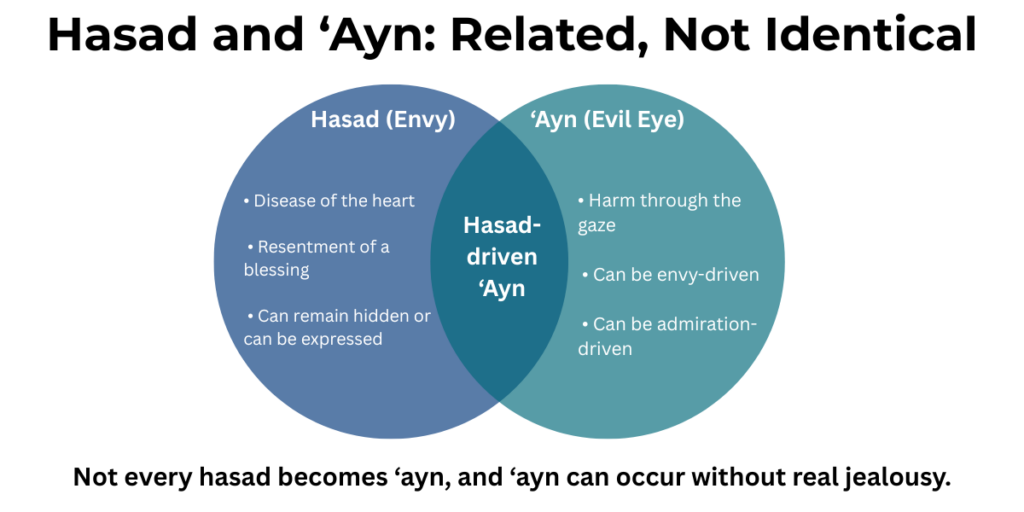
Hasad is envy in the heart: resenting another person’s blessing or wishing it would be removed.
‘Ayn (the evil eye) is the harmful effect that can occur through the gaze, by Allah’s permission, when that envy, fixation, or unchecked admiration strikes a blessing in someone’s life.
At its core, the evil eye is a spiritual strike that leaves the heart and gaze of a person, by Allah’s permission, and hits a blessing in someone else’s life. Two related concepts are important to understand here.
The first is hasad (envy). This is a corrupt feeling in the heart: disliking someone else’s blessing, wishing that it would be removed, or at least not wanting that person to have it. The second is ‘ayn (the evil eye), which is the specific effect that travels, by Allah’s permission, and harms what is looked at. Scholars explain that every instance of ‘ayn involves hasad at some level, even if mild or subconscious, but not every hasad leads to a full-blown evil eye.
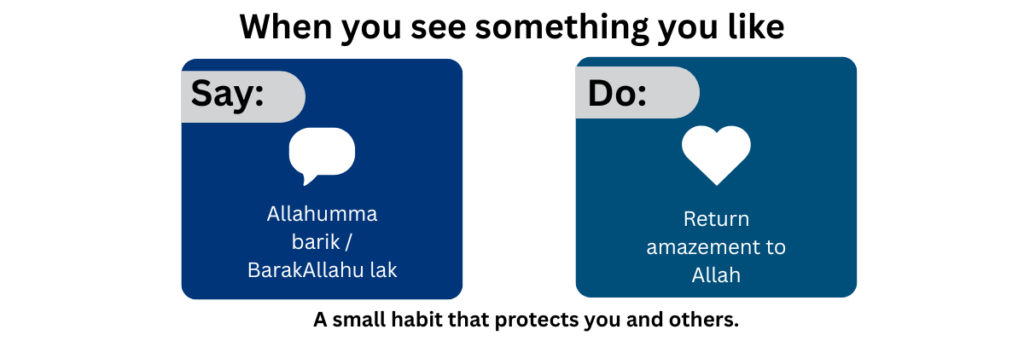
There is also a third state that confuses people. A person may be genuinely impressed or amazed by something in their own life or someone else’s, and they forget to remember Allah and to ask for blessing. Even in such a case, where there is no obvious hatred, harm can occur if Allah allows it. For this reason, the Prophet ﷺ taught us that when we see something we like, whether in ourselves or others, we should make du‘a for blessing, such as saying “BarakAllahu lak” or “Allahumma barik,” and we should return our amazement back to Allah rather than feeding our ego.
The evil eye can touch almost any worldly blessing. It may affect physical health and appearance, confidence and skills, intelligence and memory. It may touch children, fertility and pregnancy. It can harm jobs, business, wealth and reputation. It can attach to homes, cars, livestock, crops and projects. It can even target aspects of deen, such as a person’s recitation, knowledge or iman. This is one reason some people feel their life “sours” or turns upside down immediately after a period of intense exposure or praise, especially in communities where hasad is common and protection is neglected.
Allah taught us to seek refuge specifically from this harm when He said:
“And from the evil of the envier when he envies.”
(Surah Al-Falaq, 113:5)
The Prophet ﷺ did not treat the evil eye as a metaphor. He said:
“The influence of the evil eye is real. If anything were to precede the Divine Decree, it would be the influence of the evil eye.”
(Sahih Muslim)
Nothing about the evil eye escapes Allah’s decree. The existence of hasad in people’s hearts is part of how Allah tests His servants. The strike of ‘ayn, when and if it takes effect, is within His will and wisdom. The remedies – adhkar, ruqyah, sadaqah, sabr and other actions – are also causes created by Him. Believing in the evil eye does not mean people are more powerful than qadar, and it does not mean that every bad thing “must” be ‘ayn. Rather, it means that Allah has created this as one of the causes of harm in the unseen world and has informed us about it so that we can respond intelligently.
Daily protection from ‘Ayn (prevention before treatment)
Islam does not leave a believer helpless in front of the evil eye. The Sunnah teaches prevention through consistent adhkar and simple ruqyah that keeps a person protected without paranoia. The key is not intensity once in a while, but consistency every day.
Morning and evening protection (your daily shield)
Make your morning and evening adhkar non-negotiable. Seeking refuge in Allah is a direct response to the reality of the evil eye.The Mu‘awwidhat as your default refuge
Abu Sa‘id al-Khudri (رضي الله عنه) reported that the Prophet ﷺ used to seek refuge from the jinn and the evil eye until Surah al-Falaq and Surah an-Nas were revealed. After that, he held firmly to them.
A simple practice is to recite Surah al-Ikhlas, al-Falaq, and an-Nas regularly, especially within your daily adhkar and before sleep.Ruqyah is explicitly prescribed for ‘Ayn
‘Aishah (رضي الله عنها) narrated that the Prophet ﷺ ordered that ruqyah be performed for protection from the evil eye.
This keeps us grounded: ruqyah for ‘ayn is not “extra,” it is Sunnah.A short du‘a for children (and loved ones)
Ibn ‘Abbas (رضي الله عنهما) narrated that the Prophet ﷺ used to seek refuge for al-Hasan and al-Husayn and say:
U‘īdhukumā bi kalimātillāhi at-tāmmati min kulli shayṭānin wa hāmmatin wa min kulli ‘aynin lāmmah.
Meaning: I seek refuge for you both in the perfect words of Allah from every devil and poisonous creature, and from every harmful eye.
This one du‘a is especially useful because it combines protection from shayatin, harmful creatures, and the evil eye in a single line.
When you admire a blessing, seal it with barakah
When you see something you genuinely like in yourself or others, do not leave it as raw admiration. Attach it back to Allah with du‘a, such as:
Allahumma barik, or BarakAllahu lak.
It is a small habit that protects hearts, relationships, and blessings.
If you suspect ‘Ayn has occurred
When you feel you may have been affected, start with what the Sunnah already gave: seek refuge in Allah and perform ruqyah, without spiraling into suspicion or accusations. Increase the Mu‘awwidhat and keep your daily adhkar consistent.
If you want to look at how we are encouraged to treat mystical ailments like ‘Ayn in Islam, then jump ahead to Treatment Tools, which explains the accepted and effective means of treatment.
If you want to follow the natural progression of the series, read Pathway 2: Sihr. Where we take a deeper look at witchcraft and black magic.
If you want a simple structure to begin treating yourself immediately, download the 7-Day Treatment Plan.
And if you want guided support and a personalised plan, you can work with me.